“Writing and City Life”, based on NCERT .Class 11 History Chapter 1
🌍 1. Mesopotamia & Urban Beginnings
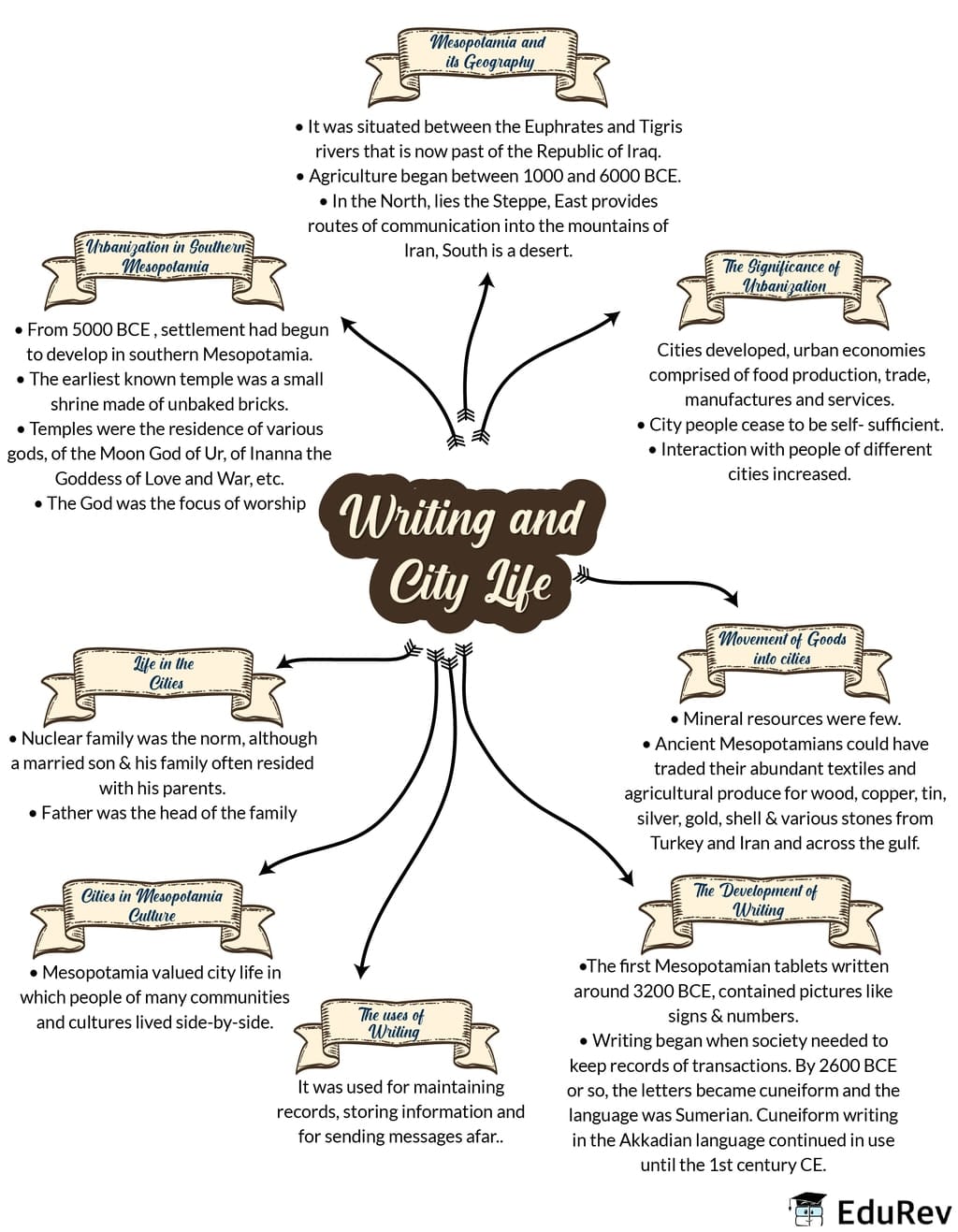
- Located in the land between the Tigris and Euphrates (modern‑day Iraq)
- Civilization developed between 6000–8000 BCE, with cities like
🚜 2. Emergence of Cities
- Division of labour: specialized crafts (e.g. seal‑makers, scribes)
- Trade & resource flow: raw materials (wood, metals, stones) came from outside; exchanged for agricultural surplus, textiles
- Urban institutions: temples, administrative centers overseen by kings/rulers
🗃️ 3. Development of Writing
- First writing appeared around 3200 BCE in southern Mesopotamia (cuneiform on clay tablets)
- Initially used for record‑keeping: lists of oxen, grain, labor, taxes (approx. 5,000 lists discovered)
📚 4. Nature & System of Writing
- Hundreds of signs; writing was a specialized skill learned by scribes
- Physically demanding: inscribing on wet clay before drying
🧾 5. Uses & Cultural Significance
- Trade transparency: writing enabled accurate tracking, bureaucracy, taxation
- Communication: messages between cities, kingdoms, even to Egypt’s Pharaoh
- Cultural symbol: writing was seen as mark of a progressive, civilized urban society
🏛️ 6. Legacy & Spread
- From c. 2000 BCE, Mesopotamian script and literature spread across the eastern Mediterranean, Syria, Turkey, into Anatolia and Egypt
- The sustained writing tradition contributed to advances in mathematics, astronomy, literature, architecture
✅ Quick Viz-Diagram Layout (for notebook drawing)
markdownCopyEdit            Writing & City Life
               /      |      \
     Mesopotamia  → Cities  → Writing
           |            \         \
        Geography     Institutions  Uses
                        |
                    Script → Spread → Legacy
— Each branch can include bullet labels: geography, trade, division of labour, scribes, record-keeping, cultural impact.
📝 Summary:
- Mesopotamia (land between rivers) saw early urban settlements.
- Cities thrived on trade and specialization, requiring systems for organization.
- Writing evolved as a tool for administration, record-keeping, and communication.
- This innovation transformed city life and became a hallmark of civilization, with far-reaching cultural influences.
NCERT SOLVED EXCERCISE
Q1. Why do we say that it was not natural fertility and high levels of food production that were the causes of early urbanisation?
Answer (Exam-oriented):
Mesopotamia’s fertile land and irrigation system produced abundant crops, but urbanisation was more than just agriculture.
Points:


- Specialised occupations – People worked as craftsmen, traders, scribes, priests.
- Trade & exchange – Surplus grain exchanged for metals, stones, and wood.
- Administrative system – Managed irrigation, taxes, and trade.
- Social hierarchy – Division into classes—kings, priests, merchants, labourers.
- Permanent settlements – Stable living encouraged institutional growth.
Conclusion:
Thus, urbanisation resulted from combined economic, administrative, and social developments, not only fertile land and good harvests.
Q2. Which of the following were necessary conditions, which were causes, and which were outcomes of early urbanisation?
Answer:
Necessary Conditions:
- Highly productive agriculture
- Water transport
- Division of labour
Causes:
- Lack of metals and stones encouraged trade
- Military power of kings ensured large labour force for projects
Outcomes:
- Use of seals for authenticating goods and maintaining records
Conclusion:
These factors together created the foundation, reasons, and results of Mesopotamian urban life.
Q3. Why were mobile animal herders not necessarily a threat to town life?
Answer:
Pastoral nomads were valuable partners to towns.
Points:
- Provided meat, milk, wool, leather, and animals.
- Received grain, tools, textiles in return.
- Served as transporters connecting distant settlements.
- Maintained trade links rather than engaging in conflict.
Conclusion:
Thus, herders supported urban economy and were allies, not enemies.
Q4. Why would the early temple have been much like a house?
Answer:
Early temples in Mesopotamia resembled large houses.
Points:
- Built with mud bricks, small in size.
- Contained a courtyard and several rooms.
- Served as symbolic home of the god.
- Stored offerings for religious rituals.
- Later became centres for storage, oil pressing, weaving, and administration.
Conclusion:
Temples evolved from small house-like shrines into major religious and economic institutions.
📄 Q5. Of the new institutions that came into being once city life began, which would have depended on the initiative of the king?
Answer:
Introduction:
The growth of urban life in Mesopotamia led to the emergence of several new institutions. Many of these were established, supported, and supervised by the king, whose leadership was essential for their success.
Role of the King:
- Temple Construction & Maintenance – Kings built and maintained temples, which acted as both religious and economic centres.
- Irrigation System Management – Ensured a steady water supply for agriculture, the base of urban life.
- Trade Route Regulation – Protected and organised long-distance trade, promoting economic growth.
- Promotion of Writing & Seal-making – Encouraged cuneiform writing and seals for record-keeping and administration.
- Support to Craftsmen & Scribes – Provided patronage to skilled workers, ensuring smooth functioning of city economy.
Conclusion:
The king’s initiative was central to Mesopotamian urban development. His authority and resources created stability, advanced the economy, and promoted culture.
Diagram:
pgsqlCopyEdit                King’s Role in Urban Institutions
                    /     |     \
         Temples  Trade  Administration
          |        |          |
   Religion+Economy   Route Security   Writing + Records
📄 Q6. What do ancient stories tell us about the civilisation of Mesopotamia?
Answer:
Introduction:
Ancient myths and archaeological evidence are key to understanding Mesopotamian civilisation. They reveal religious beliefs, social organisation, and urban culture.
What the Stories Reveal:
- Religious Beliefs – The story of Ziusudra tells of a divine flood, showing belief in gods’ control over nature.
- Fear of Natural Disasters – Floods seen as divine punishment.
- Urban Organisation – Excavations at Uruk and Mari show planned cities.
- Literacy & Record-Keeping – Use of cuneiform writing on clay tablets for administration.
- Economic Life – Temples worked as religious-economic centres, storing produce and managing crafts.
Conclusion:
Ancient stories, supported by archaeology, show Mesopotamia as a literate, organised, and prosperous civilisation with strong religious beliefs and advanced administration.
Diagram:
markdownCopyEdit      Ancient Stories + Archaeology
             /         \
    Religious Beliefs   Urban Life
       |                  |
  Flood Myths     Writing, Temples, Trade
