📚 Class 11 Political Science
Chapter 6 – Judiciary | न्यायपालिका
Complete Tabular Notes | पूर्ण सारणीबद्ध नोट्स
1. न्यायपालिका का अर्थ | Meaning of Judiciary
| हिंदी | English |
|---|---|
| न्यायपालिका सरकार का वह अंग है जो कानूनों की व्याख्या करता है, विवादों का समाधान करता है और नागरिकों के अधिकारों की रक्षा करता है। | Judiciary is the organ of government that interprets laws, settles disputes and protects the rights of citizens. |
| न्यायपालिका संविधान की रक्षा करती है। | Judiciary protects the Constitution. |
| यह सरकार की शक्तियों पर संवैधानिक नियंत्रण रखती है। | It keeps constitutional control over the powers of government. |
2. न्यायपालिका के प्रमुख कार्य
Functions of Judiciary
| क्र. | हिंदी | English |
|---|---|---|
| 1 | कानूनों की व्याख्या करना | Interpretation of laws |
| 2 | विवादों का निपटारा करना | Settlement of disputes |
| 3 | मौलिक अधिकारों की रक्षा करना | Protection of Fundamental Rights |
| 4 | संविधान की रक्षा करना | Protection of the Constitution |
| 5 | न्यायिक समीक्षा करना | Judicial Review |
| 6 | सरकार और नागरिकों के बीच विवादों का समाधान करना | Settlement of disputes between government and citizens |
| 7 | केंद्र और राज्यों के बीच संवैधानिक विवादों को सुलझाना | Settlement of constitutional disputes between Centre and States |
3. भारत की न्यायपालिका की संरचना
Structure of Indian Judiciary
| स्तर | न्यायालय | English | मुख्य कार्य |
|---|---|---|---|
| 1 | सर्वोच्च स्तर | Supreme Court | देश की सर्वोच्च अदालत |
| 2 | राज्य स्तर | High Court | राज्य के स्तर पर सर्वोच्च न्यायालय |
| 3 | जिला स्तर | District Courts | जिले के महत्वपूर्ण मामलों की सुनवाई |
| 4 | अधीनस्थ स्तर | Subordinate Courts | स्थानीय एवं निचले स्तर के मामलों की सुनवाई |
Structure
Supreme Court
⬇
High Courts
⬇
District Courts
⬇
Subordinate Courts
महत्वपूर्ण: भारत में Integrated Judicial System – एकीकृत न्यायिक व्यवस्था है।
4. सर्वोच्च न्यायालय
Supreme Court of India
| बिंदु | जानकारी |
|---|---|
| नाम | सर्वोच्च न्यायालय / Supreme Court |
| स्थिति | भारत की सर्वोच्च अदालत |
| स्थापना | 28 जनवरी 1950 |
| स्थान | नई दिल्ली / New Delhi |
| प्रमुख | Chief Justice of India (CJI) |
| न्यायाधीशों की नियुक्ति | राष्ट्रपति द्वारा |
| सेवानिवृत्ति की आयु | 65 वर्ष |
| प्रमुख कार्य | संविधान एवं मौलिक अधिकारों की रक्षा |
5. सर्वोच्च न्यायालय के न्यायाधीश की योग्यता
Qualifications of Supreme Court Judge
| योग्यता | विवरण |
|---|---|
| नागरिकता | भारत का नागरिक होना चाहिए |
| High Court Judge | कम से कम 5 वर्ष तक High Court का Judge रहा हो |
| Advocate | कम से कम 10 वर्ष तक High Court का Advocate रहा हो |
| Distinguished Jurist | राष्ट्रपति की राय में Distinguished Jurist हो |
6. न्यायाधीशों की नियुक्ति
Appointment of Judges
| बिंदु | विवरण |
|---|---|
| नियुक्ति कौन करता है? | भारत का राष्ट्रपति |
| Supreme Court Judge | President appoints the Judge |
| वर्तमान व्यवस्था में महत्वपूर्ण भूमिका | वरिष्ठ न्यायाधीशों की Collegium System द्वारा सिफारिश |
| उद्देश्य | स्वतंत्र एवं निष्पक्ष न्यायपालिका बनाए रखना |
7. न्यायाधीश का कार्यकाल और हटाना
Tenure and Removal
| विषय | विवरण |
|---|---|
| Retirement age | 65 years |
| सामान्य कार्यकाल | 65 वर्ष की आयु तक |
| इस्तीफा | राष्ट्रपति को लिखित रूप में |
| हटाने का आधार | Proved Misbehaviour या Incapacity |
| हटाने की प्रक्रिया | संसद की विशेष प्रक्रिया |
| सामान्य सरकार द्वारा हटाना | नहीं |
8. न्यायपालिका की स्वतंत्रता
Independence of Judiciary
| व्यवस्था | महत्व |
|---|---|
| सुरक्षित कार्यकाल | Judges cannot be easily removed |
| कठिन हटाने की प्रक्रिया | Political pressure से सुरक्षा |
| वेतन की सुरक्षा | Financial independence |
| न्यायिक निर्णयों में स्वतंत्रता | Independent decision-making |
| न्यायालय की अवमानना की शक्ति | Authority of courts is protected |
| कार्यपालिका से स्वतंत्रता | Executive cannot directly control judicial decisions |
उद्देश्य:
निष्पक्ष न्याय + संविधान की रक्षा + नागरिकों के अधिकारों की सुरक्षा
9. न्यायपालिका के क्षेत्राधिकार
Jurisdiction of Judiciary
| क्षेत्राधिकार | हिंदी अर्थ | मुख्य कार्य |
|---|---|---|
| Original Jurisdiction | मूल क्षेत्राधिकार | कुछ मामले सीधे Supreme Court में शुरू होते हैं |
| Appellate Jurisdiction | अपीलीय क्षेत्राधिकार | निचली अदालतों/High Courts के निर्णयों के विरुद्ध अपील |
| Advisory Jurisdiction | परामर्शदात्री क्षेत्राधिकार | राष्ट्रपति द्वारा मांगे गए महत्वपूर्ण प्रश्नों पर राय |
| Writ Jurisdiction | रिट क्षेत्राधिकार | Fundamental Rights की रक्षा के लिए Writ जारी करना |
| Judicial Review | न्यायिक समीक्षा | कानूनों की संवैधानिकता की जांच |
10. मूल क्षेत्राधिकार
Original Jurisdiction
| हिंदी | English |
|---|---|
| कुछ विवाद सीधे Supreme Court में लाए जा सकते हैं। | Certain disputes can be directly brought before the Supreme Court. |
| केंद्र और राज्य के बीच संवैधानिक विवाद | Constitutional disputes between Centre and States |
| दो या अधिक राज्यों के बीच कुछ विवाद | Certain disputes between two or more States |
11. अपीलीय क्षेत्राधिकार
Appellate Jurisdiction
| हिंदी | English |
|---|---|
| जब किसी निचली अदालत के निर्णय के विरुद्ध अपील की जाती है, तो मामला उच्च अदालत में जा सकता है। | When an appeal is made against the decision of a lower court, the case may go to a higher court. |
| Supreme Court सर्वोच्च अपीलीय अदालत है। | Supreme Court is the highest appellate court. |
12. परामर्शदात्री क्षेत्राधिकार
Advisory Jurisdiction
| हिंदी | English |
|---|---|
| राष्ट्रपति महत्वपूर्ण कानूनी या संवैधानिक प्रश्न पर Supreme Court से राय मांग सकते हैं। | The President may seek the opinion of the Supreme Court on important questions of law or fact. |
| Supreme Court अपनी राय देता है। | The Supreme Court gives its opinion. |
| यह सामान्य अपील जैसा मामला नहीं है। | It is not an ordinary appeal. |
13. न्यायिक समीक्षा
Judicial Review
| हिंदी | English |
|---|---|
| न्यायिक समीक्षा का अर्थ है कानूनों और सरकारी कार्यों की संवैधानिकता की जांच करना। | Judicial Review means examining the constitutional validity of laws and government actions. |
| न्यायालय देखता है कि कानून संविधान के अनुरूप है या नहीं। | Court examines whether a law is consistent with the Constitution. |
| असंवैधानिक कानून को न्यायालय अमान्य कर सकता है। | An unconstitutional law can be declared invalid by the court. |
सरल रूप में:
Constitution = Supreme


Law → Constitution के विरुद्ध → Court can declare it unconstitutional
14. मौलिक अधिकार और न्यायपालिका
Fundamental Rights and Judiciary
| बिंदु | विवरण |
|---|---|
| अधिकारों की रक्षा | Judiciary protects Fundamental Rights |
| Article 32 | Supreme Court में Fundamental Rights के enforcement के लिए जाने का अधिकार |
| High Court | Article 226 के तहत writs जारी कर सकता है |
| उद्देश्य | नागरिकों को न्याय दिलाना |
याद रखें:
Article 32 → Supreme Court → Fundamental Rights
Article 226 → High Court → Fundamental Rights + अन्य कानूनी अधिकार
15. रिट
Writs
| क्र. | Writ | हिंदी नाम | उद्देश्य |
|---|---|---|---|
| 1 | Habeas Corpus | बंदी प्रत्यक्षीकरण | अवैध हिरासत से व्यक्ति की रक्षा |
| 2 | Mandamus | परमादेश | सार्वजनिक अधिकारी को कानूनी कर्तव्य करने का आदेश |
| 3 | Prohibition | प्रतिषेध | निचली अदालत को अधिकार क्षेत्र से बाहर जाने से रोकना |
| 4 | Certiorari | उत्प्रेषण | निचली अदालत के मामले/निर्णय की समीक्षा के लिए उसे ऊपर मंगाना |
| 5 | Quo Warranto | अधिकार-पृच्छा | सार्वजनिक पद पर व्यक्ति के अधिकार की जांच |
Trick:
H – M – P – C – Q
16. Habeas Corpus
बंदी प्रत्यक्षीकरण
| बिंदु | विवरण |
|---|---|
| अर्थ | व्यक्ति को न्यायालय के सामने प्रस्तुत करना |
| उद्देश्य | अवैध हिरासत से सुरक्षा |
| किसके लिए | Illegal detention के मामलों में |
| सरल अर्थ | “व्यक्ति को अदालत के सामने प्रस्तुत करो।” |
17. Mandamus
परमादेश
| बिंदु | विवरण |
|---|---|
| अर्थ | आदेश देना |
| किसे | Public authority/official |
| उद्देश्य | कानूनी कर्तव्य पूरा करवाना |
| सरल अर्थ | “हम आदेश देते हैं।” |
18. Prohibition
प्रतिषेध
| बिंदु | विवरण |
|---|---|
| जारी कौन करता है? | Higher Court |
| किसके विरुद्ध? | Lower Court/Tribunal |
| उद्देश्य | अधिकार क्षेत्र से बाहर कार्य करने से रोकना |
19. Certiorari
उत्प्रेषण
| बिंदु | विवरण |
|---|---|
| जारी कौन करता है? | Higher Court |
| उद्देश्य | Lower Court/Tribunal के मामले को अपने पास मंगाना |
| उपयोग | निर्णय की समीक्षा/रद्द करने के लिए |
मुख्य अंतर:
Prohibition → रोकता है
Certiorari → मामले/निर्णय को ऊपर मंगाता है
20. Quo Warranto
अधिकार-पृच्छा
| बिंदु | विवरण |
|---|---|
| अर्थ | “किस अधिकार से?” |
| उद्देश्य | किसी व्यक्ति के सार्वजनिक पद पर बने रहने के अधिकार की जांच |
| प्रश्न | व्यक्ति इस पद पर किस कानूनी अधिकार से है? |
21. जनहित याचिका
Public Interest Litigation – PIL
| हिंदी | English |
|---|---|
| PIL का पूरा नाम जनहित याचिका है। | PIL stands for Public Interest Litigation. |
| इसका उद्देश्य व्यापक जनहित से जुड़े मामलों को न्यायालय तक पहुंचाना है। | It aims to bring matters involving public interest before the court. |
| गरीब एवं कमजोर वर्गों के हितों से जुड़े मामलों में इसका महत्व रहा है। | It has been important in matters concerning weaker and disadvantaged sections. |
| पर्यावरण, बंधुआ मजदूरी आदि मामलों में PIL का उपयोग हुआ है। | PIL has been used in matters such as environment and bonded labour. |
22. Supreme Court और High Court में अंतर
| आधार | Supreme Court | High Court |
|---|---|---|
| स्थिति | देश की सर्वोच्च अदालत | राज्य स्तर की सर्वोच्च अदालत |
| क्षेत्र | पूरा भारत | राज्य/राज्यों का क्षेत्र |
| मुख्य न्यायाधीश | Chief Justice of India | Chief Justice of High Court |
| Retirement Age | 65 years | 62 years |
| नियुक्ति | President | President |
| Writ | Article 32 | Article 226 |
| अपील | सर्वोच्च अपीलीय न्यायालय | Supreme Court में अपील हो सकती है |
23. Supreme Court की शक्तियाँ
Powers of Supreme Court
| शक्ति | विवरण |
|---|---|
| Original Jurisdiction | कुछ विवाद सीधे सुनना |
| Appellate Jurisdiction | अपील सुनना |
| Advisory Jurisdiction | राष्ट्रपति को सलाह देना |
| Writ Jurisdiction | Fundamental Rights की रक्षा |
| Judicial Review | कानूनों की संवैधानिकता जांचना |
| Court of Record | अपने निर्णयों का रिकॉर्ड रखना |
| Contempt Power | अवमानना के लिए दंड की शक्ति |
24. Court of Record
अभिलेख न्यायालय
| हिंदी | English |
|---|---|
| Supreme Court एक Court of Record है। | Supreme Court is a Court of Record. |
| इसके निर्णय और कार्यवाही स्थायी रिकॉर्ड के रूप में रखे जाते हैं। | Its judgments and proceedings are preserved as permanent records. |
| इसके रिकॉर्ड को प्रमाण के रूप में स्वीकार किया जाता है। | Its records are accepted as evidence. |
| यह अपनी अवमानना के लिए दंड दे सकता है। | It can punish for contempt of itself. |
25. न्यायपालिका और संविधान
Judiciary and Constitution
| भूमिका | Explanation |
|---|---|
| संविधान की रक्षा | Protects the Constitution |
| संविधान की व्याख्या | Interprets the Constitution |
| मौलिक अधिकारों की रक्षा | Protects Fundamental Rights |
| कानूनों की समीक्षा | Reviews laws |
| सरकार की शक्तियों पर नियंत्रण | Checks governmental powers |
| संघीय विवादों का समाधान | Resolves federal disputes |
26. न्यायपालिका की स्वतंत्रता क्यों आवश्यक है?
Why is Judicial Independence Necessary?
| कारण | Explanation |
|---|---|
| निष्पक्ष न्याय | To provide impartial justice |
| नागरिक अधिकारों की रक्षा | To protect citizens’ rights |
| संविधान की सर्वोच्चता | To maintain supremacy of Constitution |
| सरकार पर नियंत्रण | To check misuse of governmental power |
| लोकतंत्र की रक्षा | To protect democracy |
⭐ पूरे Chapter का Quick Revision Table
| Topic | याद रखने योग्य तथ्य |
|---|---|
| Judiciary | न्यायपालिका |
| Supreme Court | भारत की सर्वोच्च अदालत |
| Supreme Court स्थापना | 28 January 1950 |
| Location | New Delhi |
| Supreme Court Judge Retirement | 65 years |
| High Court Judge Retirement | 62 years |
| Judge Appointment | President |
| Original Jurisdiction | मूल क्षेत्राधिकार |
| Appellate Jurisdiction | अपीलीय क्षेत्राधिकार |
| Advisory Jurisdiction | परामर्शदात्री क्षेत्राधिकार |
| Judicial Review | न्यायिक समीक्षा |
| PIL | Public Interest Litigation |
| Article 32 | Fundamental Rights enforcement through Supreme Court |
| Article 226 | High Court’s writ jurisdiction |
| Writs | 5 |
| Habeas Corpus | बंदी प्रत्यक्षीकरण |
| Mandamus | परमादेश |
| Prohibition | प्रतिषेध |
| Certiorari | उत्प्रेषण |
| Quo Warranto | अधिकार-पृच्छा |
| Court of Record | अभिलेख न्यायालय |
| Judicial Independence | न्यायपालिका की स्वतंत्रता |
| Integrated Judiciary | एकीकृत न्यायिक व्यवस्था |
Class 11 Political Science
Chapter 6 – Judiciary
NCERT Exercise – Solved
Hindi + English
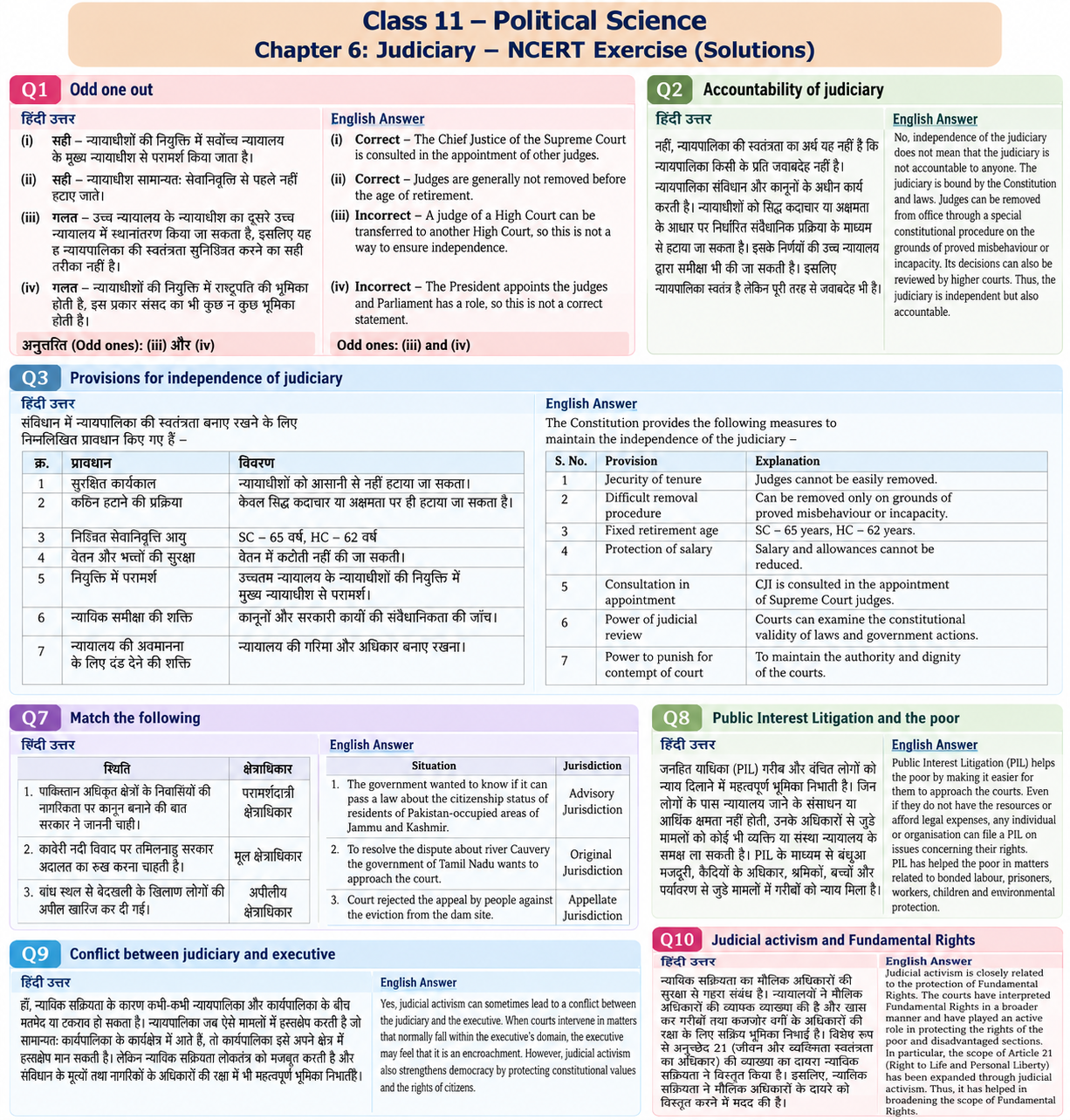
Q1. What are the different ways in which the independence of the judiciary is ensured? Choose the odd ones out.
प्रश्न:
न्यायपालिका की स्वतंत्रता सुनिश्चित करने के विभिन्न तरीके क्या हैं? इनमें से गलत कथन चुनिए।
Answer:
(i) Chief Justice of the Supreme Court is consulted in the appointment of other judges of Supreme Court.
सही (Correct) – अन्य न्यायाधीशों की नियुक्ति में Chief Justice से परामर्श किया जाता है।
(ii) Judges are generally not removed before the age of retirement.
सही (Correct) – न्यायाधीशों को सामान्यतः सेवानिवृत्ति की आयु से पहले आसानी से नहीं हटाया जा सकता।
(iii) Judge of a High Court cannot be transferred to another High Court.
गलत (Incorrect) – High Court के न्यायाधीश का दूसरे High Court में स्थानांतरण किया जा सकता है।
(iv) Parliament has no say in the appointment of judges.
सही (Correct) – न्यायाधीशों की नियुक्ति में संसद की प्रत्यक्ष भूमिका नहीं होती।
Answer: (iii) is the odd one out.
Q2. Does independence of the judiciary mean that the judiciary is not accountable to anyone?
हिंदी प्रश्न:
क्या न्यायपालिका की स्वतंत्रता का अर्थ यह है कि न्यायपालिका किसी के प्रति जवाबदेह नहीं है?
हिंदी उत्तर:
नहीं। न्यायपालिका की स्वतंत्रता का अर्थ यह नहीं है कि वह किसी के प्रति जवाबदेह नहीं है। न्यायपालिका संविधान और कानूनों के अनुसार कार्य करती है। न्यायाधीशों को सिद्ध कदाचार (Proved Misbehaviour) या अक्षमता (Incapacity) के आधार पर निर्धारित संवैधानिक प्रक्रिया द्वारा हटाया जा सकता है। इसके अतिरिक्त, न्यायालयों के निर्णयों की उच्च न्यायालयों द्वारा समीक्षा की जा सकती है। इसलिए न्यायपालिका स्वतंत्र होने के साथ-साथ संविधान के प्रति जवाबदेह भी है।
English Answer:
No. Independence of the judiciary does not mean that the judiciary is not accountable to anyone. The judiciary functions according to the Constitution and laws. Judges can be removed through a prescribed constitutional procedure on grounds of proved misbehaviour or incapacity. Judicial decisions can also be reviewed by higher courts. Thus, the judiciary is independent but remains accountable to the Constitution and law.
Q3. What are the different provisions in the Constitution in order to maintain the independence of judiciary?
हिंदी प्रश्न:
न्यायपालिका की स्वतंत्रता बनाए रखने के लिए संविधान में कौन-कौन से प्रावधान किए गए हैं?
हिंदी उत्तर:
भारतीय संविधान में न्यायपालिका की स्वतंत्रता बनाए रखने के लिए निम्नलिखित प्रावधान किए गए हैं:
| क्र. | प्रावधान | विवरण |
|---|---|---|
| 1. | न्यायाधीशों का सुरक्षित कार्यकाल | न्यायाधीशों को आसानी से पद से नहीं हटाया जा सकता। |
| 2. | कठिन हटाने की प्रक्रिया | न्यायाधीशों को हटाने के लिए संसद में विशेष प्रक्रिया आवश्यक है। |
| 3. | वेतन एवं भत्तों की सुरक्षा | न्यायाधीशों के वेतन और भत्तों को सुरक्षा प्राप्त है। |
| 4. | नियुक्ति में न्यायपालिका की भूमिका | न्यायाधीशों की नियुक्ति में Chief Justice और वरिष्ठ न्यायाधीशों की महत्वपूर्ण भूमिका है। |
| 5. | न्यायिक समीक्षा की शक्ति | न्यायालय कानूनों और सरकारी कार्यों की संवैधानिकता की जाँच कर सकते हैं। |
| 6. | अवमानना की शक्ति | न्यायालय अपनी अवमानना के लिए दंड दे सकते हैं। |
| 7. | न्यायिक निर्णयों में स्वतंत्रता | न्यायालय बिना अनुचित राजनीतिक दबाव के निर्णय लेते हैं। |
English Answer:
The Constitution provides several safeguards to maintain the independence of the judiciary:
| S.No. | Provision | Explanation |
|---|---|---|
| 1. | Security of tenure | Judges cannot be easily removed from office. |
| 2. | Difficult removal procedure | A special procedure is required for the removal of judges. |
| 3. | Protection of salaries and allowances | Their salaries and allowances are protected. |
| 4. | Role of judiciary in appointments | The Chief Justice and senior judges have an important role in judicial appointments. |
| 5. | Power of Judicial Review | Courts can examine the constitutional validity of laws and government actions. |
| 6. | Power to punish for contempt | Courts can punish for contempt of court. |
| 7. | Independence in decision-making | Courts can take decisions without improper political interference. |
Q7. Match the following situations with the different jurisdictions of the Supreme Court.
हिंदी में उत्तर:
| स्थिति | क्षेत्राधिकार | कारण |
|---|---|---|
| 1. सरकार यह जानना चाहती है कि क्या वह जम्मू-कश्मीर के पाकिस्तान-अधिकृत क्षेत्रों के निवासियों की नागरिकता के संबंध में कानून बना सकती है। | Advisory Jurisdiction – परामर्शदात्री क्षेत्राधिकार | सरकार Supreme Court से कानूनी/संवैधानिक प्रश्न पर राय मांग रही है। |
| 2. कावेरी नदी के विवाद को हल करने के लिए तमिलनाडु सरकार न्यायालय जाना चाहती है। | Original Jurisdiction – मूल क्षेत्राधिकार | यह राज्यों के बीच विवाद से संबंधित मामला है। |
| 3. न्यायालय ने बाँध स्थल से विस्थापन के विरुद्ध लोगों की अपील को खारिज कर दिया। | Appellate Jurisdiction – अपीलीय क्षेत्राधिकार | पहले दिए गए निर्णय के विरुद्ध अपील की गई है। |
Final Answer:
1 → Advisory Jurisdiction
2 → Original Jurisdiction
3 → Appellate Jurisdiction
Q8. In what way can Public Interest Litigation help the poor?
हिंदी उत्तर:
जनहित याचिका (Public Interest Litigation – PIL) गरीब और कमजोर वर्गों को न्याय दिलाने में सहायता करती है। गरीब लोग अक्सर न्यायालय में जाने का खर्च नहीं उठा पाते या उन्हें अपने अधिकारों की पर्याप्त जानकारी नहीं होती। PIL के माध्यम से कोई व्यक्ति या संस्था उनके अधिकारों और हितों से संबंधित मामला न्यायालय के सामने रख सकती है।
PIL का उपयोग बंधुआ मजदूरों, कैदियों, श्रमिकों, बच्चों तथा पर्यावरण से जुड़े मामलों में किया गया है। इससे गरीब और वंचित लोगों को न्याय तक पहुँचने का अवसर मिलता है।
English Answer:
Public Interest Litigation (PIL) can help the poor by making access to justice easier for disadvantaged people. Poor people may not have enough money, resources or knowledge to approach courts themselves. Through PIL, an individual or organisation can bring issues concerning their rights and welfare before the court.
PIL has been used in matters relating to bonded labourers, prisoners, workers, children and environmental protection. Thus, it helps disadvantaged sections get access to justice.
Q9. Do you think that judicial activism can lead to a conflict between the judiciary and the executive? Why?
हिंदी उत्तर:
हाँ, न्यायिक सक्रियता (Judicial Activism) के कारण कभी-कभी न्यायपालिका और कार्यपालिका के बीच मतभेद उत्पन्न हो सकते हैं।
जब न्यायालय ऐसे मामलों में सक्रिय भूमिका निभाता है जो सामान्यतः कार्यपालिका के कार्यक्षेत्र से संबंधित होते हैं, तो कार्यपालिका इसे अपने अधिकार क्षेत्र में हस्तक्षेप मान सकती है। इससे दोनों के बीच तनाव या मतभेद उत्पन्न हो सकता है।
हालाँकि, न्यायिक सक्रियता का उद्देश्य संविधान, मौलिक अधिकारों और जनहित की रक्षा करना भी है।
English Answer:
Yes, judicial activism can sometimes lead to a conflict between the judiciary and the executive.
When courts take an active role in matters that normally fall within the executive’s area of functioning, the executive may consider it an interference in its domain. This can create differences between the two institutions.
However, judicial activism can also play an important role in protecting the Constitution, Fundamental Rights and public interest.
Q10. How is judicial activism related to the protection of Fundamental Rights? Has it helped in expanding the scope of Fundamental Rights?
हिंदी उत्तर:
न्यायिक सक्रियता का मौलिक अधिकारों की रक्षा से गहरा संबंध है। न्यायपालिका ने मौलिक अधिकारों की व्यापक व्याख्या करके नागरिकों के अधिकारों की सुरक्षा में महत्वपूर्ण भूमिका निभाई है।
विशेष रूप से अनुच्छेद 21 – जीवन और व्यक्तिगत स्वतंत्रता के अधिकार की न्यायालयों ने व्यापक व्याख्या की है। इसके अंतर्गत गरिमापूर्ण जीवन से जुड़े कई अधिकारों को न्यायिक व्याख्या के माध्यम से संरक्षण मिला है।
इस प्रकार, न्यायिक सक्रियता ने मौलिक अधिकारों के दायरे को व्यापक बनाने और उनकी प्रभावी सुरक्षा में योगदान दिया है।
English Answer:
Judicial activism is closely related to the protection of Fundamental Rights. The judiciary has played an important role in protecting citizens’ rights by interpreting Fundamental Rights broadly.
In particular, courts have given a wider interpretation to Article 21 – Right to Life and Personal Liberty. Several rights connected with living a life with dignity have received protection through judicial interpretation.
Thus, judicial activism has contributed to expanding the scope and effective protection of Fundamental Rights.
