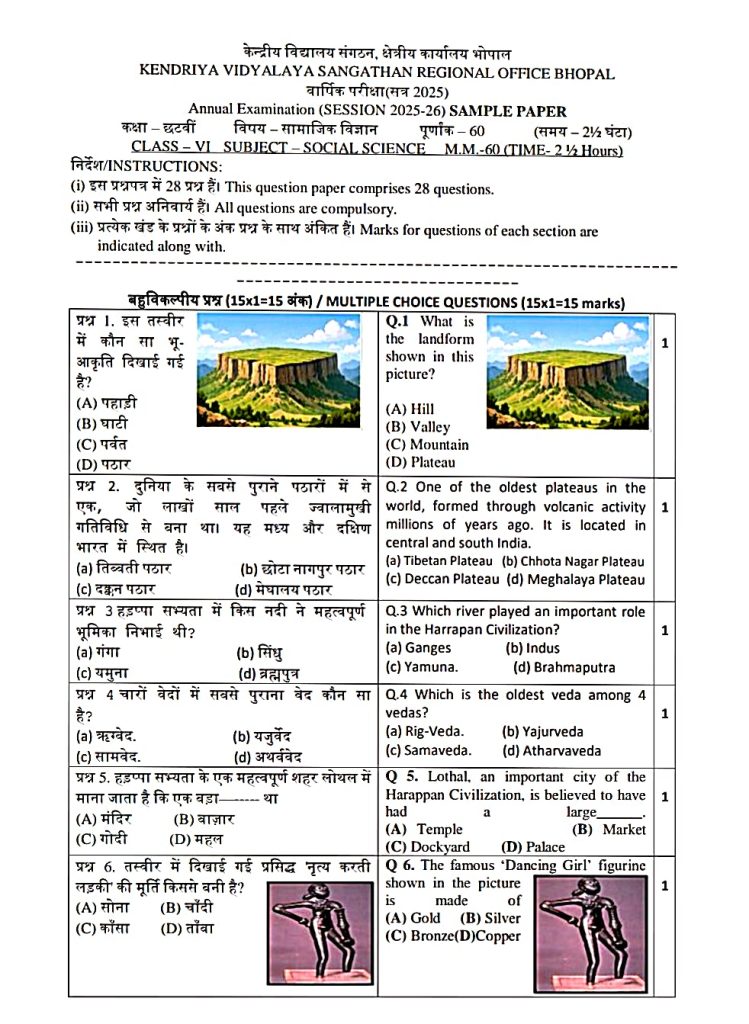
Section – A (Multiple Choice Questions)
Q1. What is the landform shown in this picture?
Answer: (D) Plateau – पठार
Q2. One of the oldest plateaus in the world located in central and south India?
Answer: (C) Deccan Plateau – दक्कन पठार
Q3. Which river played an important role in the Harappan Civilization?
Answer: (B) Indus – सिंधु नदी
Q4. Which is the oldest Veda among the four Vedas?
Answer: (A) Rigveda – ऋग्वेद


Q5. Lothal city of Harappan civilization had a large ______.
Answer: (C) Dockyard – गोदी
Q6. The famous ‘Dancing Girl’ figurine is made of:
Answer: (C) Bronze – कांसा
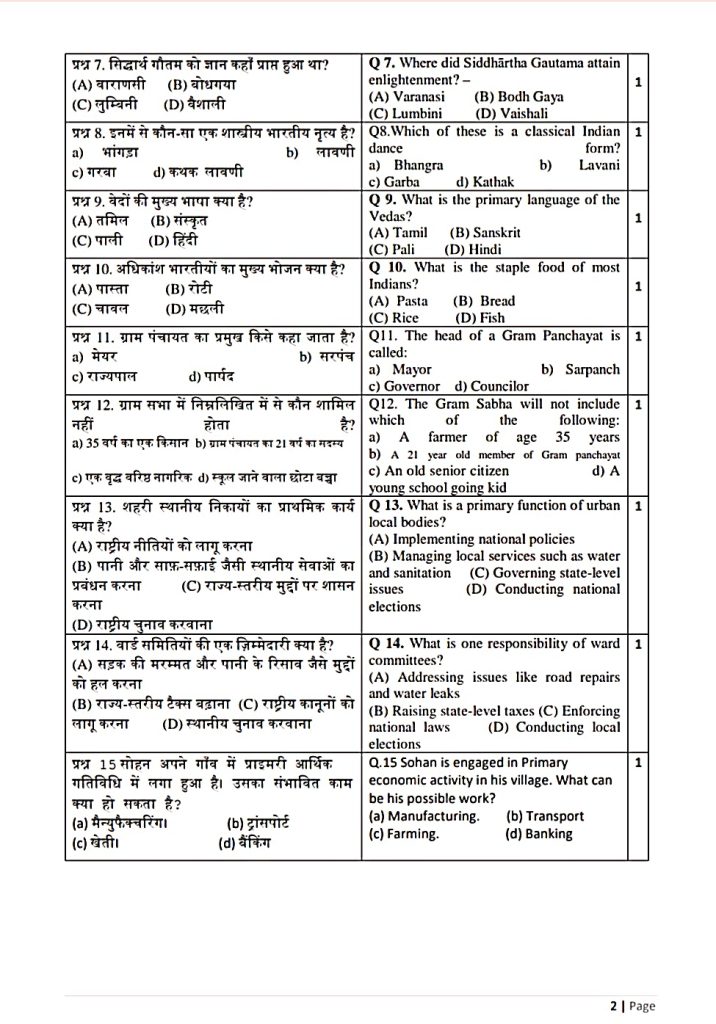
Section – A (MCQ Answers)
Q7. Where did Siddhartha Gautama attain enlightenment?
Answer: (B) Bodh Gaya
Q8. Which of these is a classical Indian dance form?
Answer: (D) Kathak
Q9. What is the primary language of the Vedas?
Answer: (B) Sanskrit
Q10. What is the staple food of most Indians?
Answer: (C) Rice
Q11. The head of a Gram Panchayat is called:
Answer: (B) Sarpanch
Q12. The Gram Sabha will not include which of the following?
Answer: (D) A young school going kid
Q13. What is a primary function of urban local bodies?
Answer: (B) Managing local services such as water and sanitation
Q14. What is one responsibility of ward committees?
Answer: (A) Addressing issues like road repairs and water leaks
Q15. Sohan is engaged in primary economic activity. What can be his work?
Answer: (C) Farming
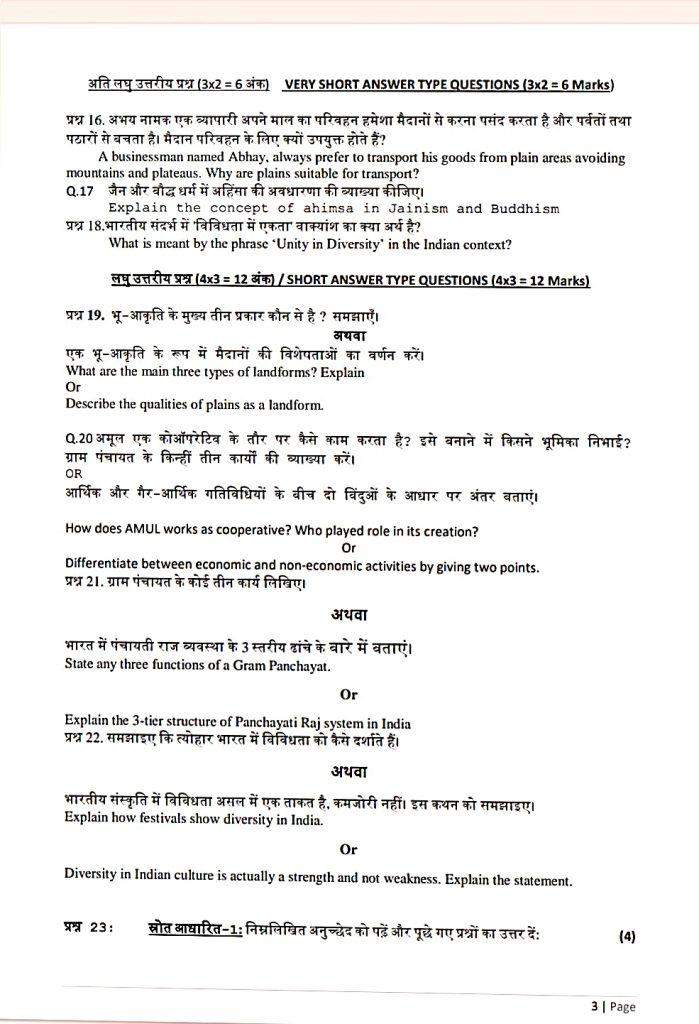
Very Short Answer (Q16–18)
Q16. Why are plains suitable for transport?
Answer:
Plains are suitable for transport because the land is flat and even. It is easier to build roads, railways and airports on plains, so transportation becomes fast and convenient.
Q17. Explain the concept of ahimsa in Jainism and Buddhism.
Answer:
Ahimsa means not harming any living being. Both Jainism and Buddhism teach people to live with peace, kindness and compassion towards all living creatures.
Q18. What is meant by ‘Unity in Diversity’ in the Indian context?
Answer:
Unity in Diversity means that people of different religions, languages and cultures live together peacefully in India while maintaining unity.
Short Answer (Q19–22)
Q19. What are the main three types of landforms?
Answer:
The three main types of landforms are:
- Mountains – Very high landforms with steep slopes.
- Plateaus – Flat land raised above the surrounding area.
- Plains – Large flat and low-lying areas suitable for farming and settlements.
Q20. How does AMUL work as a cooperative? Who played a role in its creation?
Answer:
AMUL works as a cooperative society where milk farmers join together and sell their milk collectively. This helps farmers get a fair price for their milk.
Dr. Verghese Kurien played an important role in the creation and success of AMUL.
Q21. State any three functions of a Gram Panchayat.
Answer:
Three functions of Gram Panchayat are:
- Maintaining roads, wells and public places.
- Providing clean drinking water and sanitation.
- Looking after development work in the village.
Q22. Explain how festivals show diversity in India.
Answer:
India celebrates many festivals like Diwali, Eid, Christmas, Baisakhi and Pongal. These festivals belong to different religions and cultures. People celebrate them with joy and respect, which shows the diversity of Indian society.
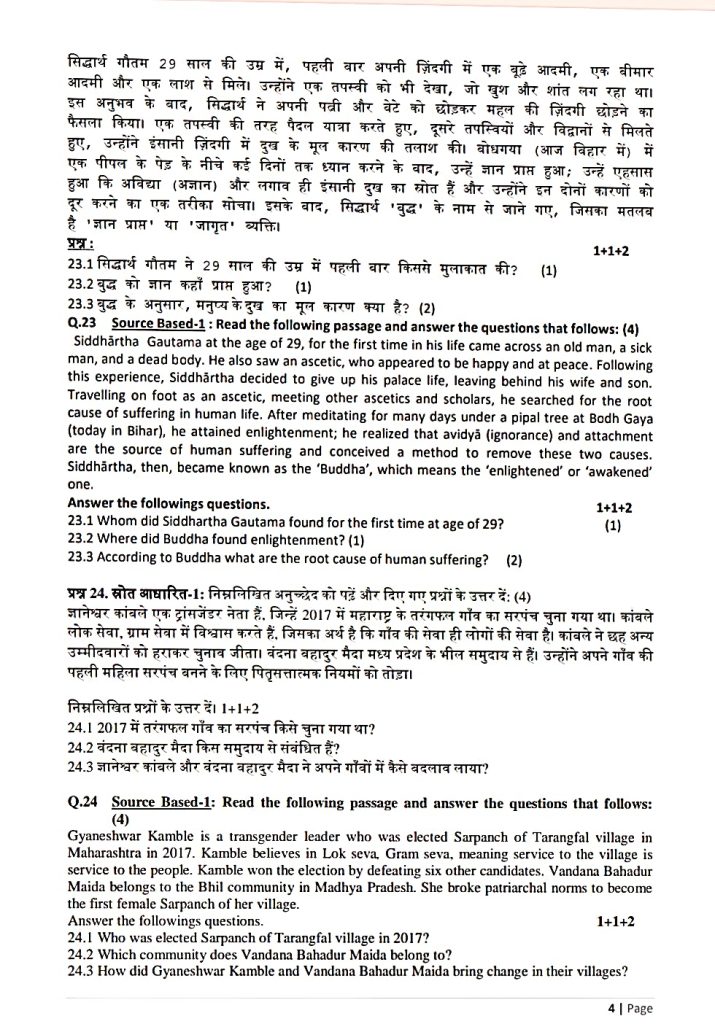
Q23. Source Based Questions
23.1 Whom did Siddhartha Gautama find for the first time at age of 29?
Answer:
Siddhartha Gautama saw an old man, a sick man, a dead body and an ascetic (monk) for the first time.
23.2 Where did Buddha find enlightenment?
Answer:
Buddha attained enlightenment at Bodh Gaya in Bihar under a Peepal (Bodhi) tree.
23.3 According to Buddha, what are the root causes of human suffering?
Answer:
According to Buddha, the root causes of human suffering are Avidya (ignorance) and attachment (desire).
Q24. Source Based Questions
24.1 Who was elected Sarpanch of Tarangfal village in 2017?
Answer:
Gyaneshwar Kamble was elected Sarpanch of Tarangfal village in 2017.
24.2 Which community does Vandana Bahadur Maida belong to?
Answer:
Vandana Bahadur Maida belongs to the Bhil community.
24.3 How did Gyaneshwar Kamble and Vandana Bahadur Maida bring change in their villages?
Answer:
Gyaneshwar Kamble worked for public service and development of the village.
Vandana Bahadur Maida broke patriarchal norms and became the first female Sarpanch, bringing social change in her village.
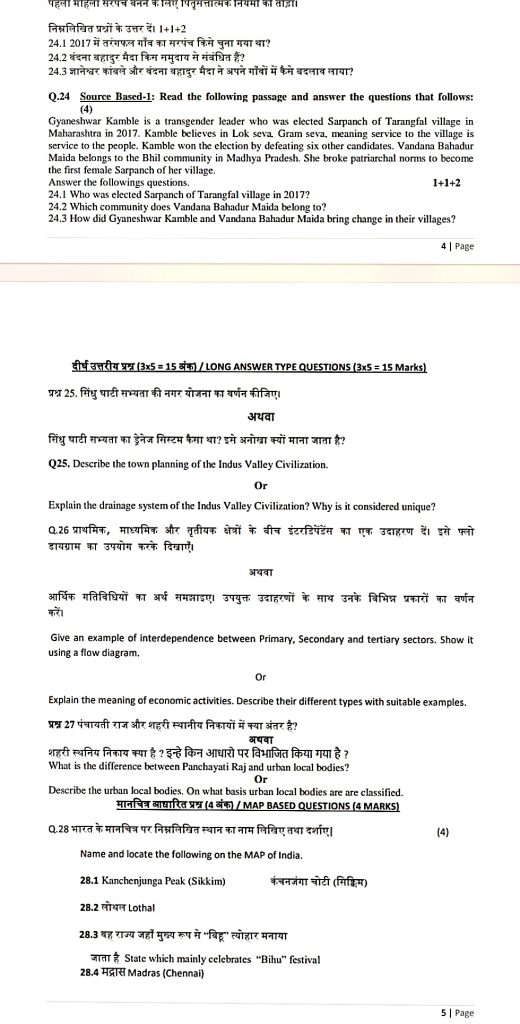
Q25. Describe the town planning of the Indus Valley Civilization.
Answer:
The Indus Valley Civilization had a very well-planned system of town planning.
- Cities were divided into two parts – Citadel and Lower Town.
- Roads were wide and straight and cut each other at right angles.
- Houses were made of baked bricks and many houses had two storeys.
- Almost every house had a bathroom and a well.
- Cities had a very advanced drainage system with covered drains.
This shows that the Indus Valley people were very organized and skilled in city planning.
Q26. Explain the meaning of economic activities and their types.
Answer:
Economic activities are the activities that people do to earn money for their livelihood.
There are three main types:
1. Primary activities
These involve using natural resources.
Example: Farming, fishing, mining.
2. Secondary activities
These involve manufacturing goods from raw materials.
Example: Factories, industries.
3. Tertiary activities
These provide services to people.
Example: Transport, banking, teaching, doctors.
Q27. What is the difference between Panchayati Raj and Urban Local Bodies?
| Panchayati Raj | Urban Local Bodies |
|---|---|
| Works in rural areas (villages) | Works in urban areas (cities and towns) |
| Main body is Gram Panchayat | Main bodies are Municipal Corporation and Municipality |
| Responsible for village development | Responsible for city services like water, roads and sanitation |
Q28. Map Based Questions
28.1 Kanchenjunga Peak – Sikkim (Himalayan region)
28.2 Lothal – Gujarat
28.3 State which celebrates Bihu festival – Assam
28.4 Madras (Chennai) – Tamil Nadu
KVS CLASS 6 SOCIAL SCIENCE (TERM-2) – MODEL SOLVED PAPER
Session: 2025–26
Time: 3 Hours Max Marks: 80
SECTION A – Objective Type Questions
(1 Mark each)
- Which landform is known as a “Tableland”?
Ans: Plateau - In which state is the Harappan site Lothal located?
Ans: Gujarat - The head of a Gram Panchayat is called:
Ans: Sarpanch - Which of these is a Primary economic activity?
(a) Teaching
(b) Banking
(c) Farming
(d) Manufacturing
Ans: (c) Farming
- The Great Bath was found in which Harappan city?
Ans: Mohenjo-daro - Who is the administrative head of a Municipal Corporation?
Ans: Municipal Commissioner - What is the minimum age to vote in a Gram Sabha?
Ans: 18 years - Mountains arranged in a line are called:
Ans: Mountain Range - ‘Unity in Diversity’ reflects the idea that:
Ans: Different cultures, languages and religions live together in harmony in India. - Economic activities that provide services belong to which sector?
Ans: Tertiary Sector
SECTION B – Very Short Answer Questions
(2 Marks each)
1. Define Unity in Diversity in the Indian context.
Ans:
Unity in Diversity means people of different religions, languages, cultures and traditions living together peacefully as one nation in India.
2. Name two important features of Harappan drainage system.
Ans:
- Drains were covered with stone slabs or bricks.
- They were built in straight lines and connected to the main drain.
3. What are the three levels of Panchayati Raj system?
Ans:
- Gram Panchayat – Village level
- Panchayat Samiti – Block level
- Zila Parishad – District level
SECTION C – Short Answer Questions
(3 Marks each)
1. How are mountains useful to us?
Ans:
- Mountains are storehouses of water as many rivers originate from them.
- They have rich forests and wildlife.
- They promote tourism and provide forest products like fuel, fodder and medicinal plants.
2. Differentiate between Rural and Urban Local Bodies.
| Rural Local Bodies | Urban Local Bodies |
|---|---|
| Work in villages | Work in towns and cities |
| Called Panchayats | Called Municipalities or Corporations |
| Focus on village roads, water, sanitation | Focus on city services like water supply, garbage disposal, street lights |
3. Explain Economic Activities with examples.
Ans:
Economic activities are activities that people perform to earn their livelihood.
Examples:
- Primary activities: Farming, fishing, mining
- Secondary activities: Manufacturing goods in factories
- Tertiary activities: Services such as teaching, banking and transport
SECTION D – Long Answer Questions
(5 Marks each)
1. Describe the life of people in a Harappan city.
Ans:
Harappan cities were well planned and had different groups of people.
- Rulers: They planned the cities and maintained order.
- Craftspersons: Made tools, jewellery, pottery and seals.
- Traders: Traded goods with distant regions.
- Farmers and Herders: Grew crops and reared animals to supply food.
- Scribes: Wrote on seals using the Harappan script.
2. Explain the functions of a Municipal Corporation.
Ans:
A Municipal Corporation manages the administration of large cities.
Main functions include:
- Supplying clean drinking water.
- Garbage collection and sanitation.
- Maintaining roads, parks and street lights.
- Running schools, hospitals and dispensaries.
- Keeping records of births and deaths.
SECTION E – Case-Based Question
(4 Marks)
Read the passage and answer the questions:
“In a Gram Sabha meeting, villagers discuss the scarcity of water. Some suggest piping water from a nearby river, while others suggest deepening the handpumps. The Panchayat President (Sarpanch) reviews the budget.”
1. Who forms the Gram Sabha?
Ans: All adults above 18 years of age living in the village.
2. Why is the Gram Sabha important?
Ans: It keeps the Panchayat accountable and allows villagers to participate in decision-making.
SECTION F – Map Work
(5 Marks)
On an outline map of India, locate and label the following:
- Lothal – Gujarat
- Kalibangan – Rajasthan
- Himalayan Range – Northern India
- River Ganga
- Deccan Plateau
✅ Total Marks: 80
Based on the 2025–26 KVS blueprint and the new NCERT textbook “Exploring Society: India and Beyond,” here are 20 sample MCQs. These cover key themes like Geography (The Earth), History (Our Pasts), and Civics (Governance and Democracy).
Geography: Land & People
- Which imaginary line divides the Earth into the Northern and Southern Hemispheres?
- (a) Tropic of Cancer
- (b) Equator ✅
- (c) Arctic Circle
- (d) Prime Meridian
The Equator is the $0^\circ$ latitude that divides the globe equally.
- Which is the largest continent on Earth?
- (a) Africa
- (b) Europe
- (c) Asia ✅
- (d) North America
Asia covers about one-third of the total land area of the Earth.
- What do we call a landform that is higher than the surrounding area but has a flat top?
- (a) Mountain
- (b) Plateau ✅
- (c) Plain
- (d) Valley
Plateaus are often called “tablelands” due to their flat tops.
- Which ocean is named after a country?
- (a) Pacific Ocean
- (b) Atlantic Ocean
- (c) Indian Ocean ✅
- (d) Arctic Ocean
The Indian Ocean is the only one named after a specific nation.
- A drawing of the Earth’s surface or a part of it on a flat surface is called a:
- (a) Globe
- (b) Map ✅
- (c) Sketch
- (d) Plan
Maps are essential tools for representing geography on paper.
History: India and the World
- The term “Purana” literally means:
- (a) Modern
- (b) New
- (c) Old ✅
- (d) Civilized
Puranas are ancient Indian texts containing mythological stories.
- Who was the famous mathematician and astronomer of ancient India?
- (a) Kalidasa
- (b) Aryabhatta ✅
- (c) Banabhatta
- (d) Surdasa
Aryabhatta wrote the ‘Aryabhatiya’ and explained the causes of eclipses.
- Where was the first place Gautam Buddha went to teach after gaining enlightenment?
- (a) Bodh Gaya
- (b) Sarnath ✅
- (c) Kushinagar
- (d) Lumbini
Buddha delivered his first sermon at Sarnath, near Varanasi.
- The Iron Pillar of Mehrauli is famous for not rusting; it is located in:
- The Harappan Civilization is also known as:
- (a) Vedic Civilization
- (b) Indus Valley Civilization ✅
- (c) Mesopotamian Civilization
- (d) Egyptian Civilization
It flourished around the Indus river system.
Civics: Governance & Democracy
- Who is known as the “Father of the Indian Constitution”?
- (a) Mahatma Gandhi
- (b) Dr. B.R. Ambedkar ✅
- (c) Jawaharlal Nehru
- (d) Sardar Patel
He was the chairman of the Drafting Committee.
- “Grassroots Democracy” refers to governance at which level?
- (a) National level
- (b) State level
- (c) Local/Village level ✅
- (d) International level
It involves the participation of people at the basic community level.
- Who is responsible for measuring land and keeping land records in a village?
- (a) Sarpanch
- (b) Patwari ✅
- (c) Police Constable
- (d) District Collector
The Patwari (or Lekhpal) maintains rural land records.
- The “Gram Sabha” consists of:
- (a) All children in the village
- (b) Only the Sarpanch and Panchs
- (c) All adults who are registered voters in the village ✅
- (d) Only the wealthy landowners
It is the foundation of the Panchayati Raj system.
- Which of these is a harvest festival celebrated in Kerala?
- (a) Bihu
- (b) Onam ✅
- (c) Pongal
- (d) Makar Sankranti
Onam is famous for boat races and floral decorations.
General Awareness & Economics
- How many villages are there in India approximately?
- (a) 1 Lakh
- (b) 6 Lakhs ✅
- (c) 10 Lakhs
- (d) 50,000
India is primarily a land of villages.
- Which of these is a “non-renewable” resource?
- (a) Solar Energy
- (b) Wind
- (c) Coal ✅
- (d) Water
Coal takes millions of years to form and cannot be easily replaced.
- Urbanization is the process of people moving from:
- (a) Cities to villages
- (b) One country to another
- (c) Rural areas to cities ✅
- (d) Mountains to plains
It usually occurs in search of better jobs and education.
- The “National Song” of India was written by:
- (a) Rabindranath Tagore
- (b) Bankim Chandra Chatterjee ✅
- (c) Sarojini Naidu
- (d) Subhash Chandra Bose
The song ‘Vande Mataram’ was composed by him.
- Which is the festival of lights celebrated across India?
- (a) Holi
- (b) Dussehra
- (c) Diwali ✅
- (d) Eid
Diwali symbolises the victory of light over darkness.
