Chapter 7: Globalisation (वैश्वीकरण)

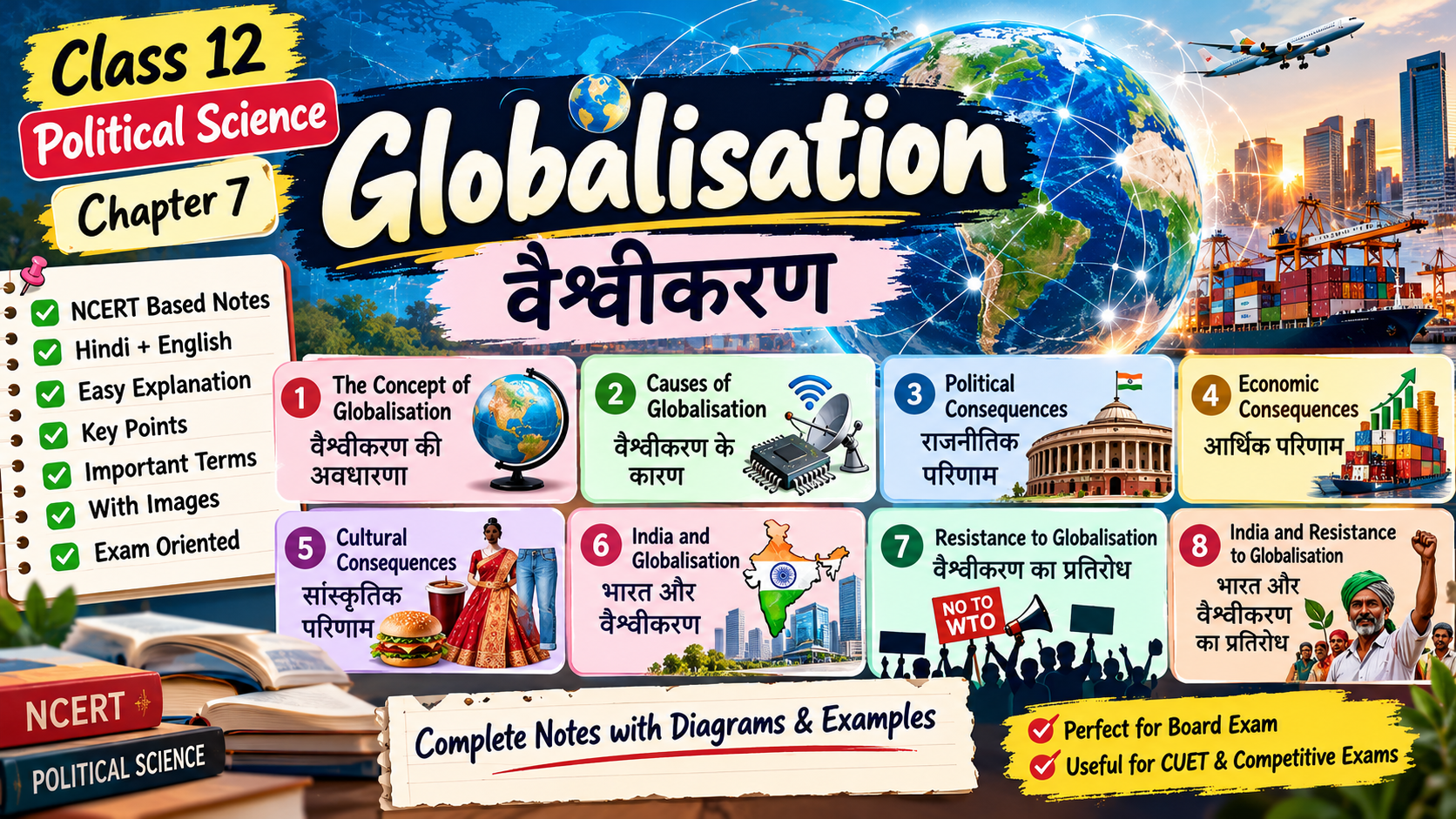
1. The Concept of Globalisation — वैश्वीकरण की अवधारणा
English: Globalisation refers to worldwide interconnectedness created through the flow of ideas, capital, commodities and people across national boundaries.
हिंदी: वैश्वीकरण का अर्थ राष्ट्रीय सीमाओं के पार विचारों, पूँजी, वस्तुओं और लोगों के प्रवाह से विश्व के विभिन्न भागों के बीच आपसी जुड़ाव बढ़ना है।
NCERT के मुख्य बिंदु / Key Points
- Globalisation is a multi-dimensional concept. It has political, economic and cultural dimensions.
- वैश्वीकरण एक बहुआयामी अवधारणा है। इसके राजनीतिक, आर्थिक और सांस्कृतिक आयाम हैं।
- It is not always positive; it may also have negative consequences.
- इसके परिणाम हमेशा सकारात्मक नहीं होते; इसके नकारात्मक प्रभाव भी हो सकते हैं।
- Its impact is uneven across different societies and sections of society.
- इसका प्रभाव विभिन्न समाजों और समाज के अलग-अलग वर्गों पर समान नहीं पड़ता।
2. Causes of Globalisation — वैश्वीकरण के कारण

English: Globalisation has a long historical background. In the contemporary era, the speed and scale of global flows have increased significantly.

हिंदी: वैश्वीकरण की ऐतिहासिक पृष्ठभूमि पुरानी है। समकालीन दौर में वैश्विक प्रवाह की गति और व्यापकता में काफी वृद्धि हुई है।
- Technology (तकनीक): The telegraph, telephone and microchip revolutionised communication.
- Improved communication (बेहतर संचार): Information travels rapidly across the world.
- Movement of capital and commodities (पूँजी एवं वस्तुओं का प्रवाह): Technology makes international transactions and trade easier.
- Movement of people and ideas (लोगों एवं विचारों का प्रवाह): People move for livelihoods, while ideas spread across borders.
- Worldwide interconnections (वैश्विक परस्पर जुड़ाव): Events in one part of the world can affect other parts.
3. Political Consequences — राजनीतिक परिणाम
English: Globalisation influences the capacity, functions and sovereignty of the state.
हिंदी: वैश्वीकरण राज्य की कार्यक्षमता, कार्यों और संप्रभुता को प्रभावित करता है।
- Erosion of state capacity: In some areas, governments may lose some ability to determine economic and social priorities.
- राज्य की क्षमता में कमी: कुछ क्षेत्रों में सरकार की आर्थिक और सामाजिक प्राथमिकताएँ तय करने की क्षमता घट सकती है।
- Changing welfare state: Some welfare functions may be reduced as the market gains importance.
- कल्याणकारी राज्य में बदलाव: बाजार की भूमिका बढ़ने से कुछ कल्याणकारी कार्य कम हो सकते हैं।
- Role of MNCs: Multinational companies influence economic decisions.
- बहुराष्ट्रीय कंपनियों की भूमिका: बहुराष्ट्रीय कंपनियाँ आर्थिक निर्णयों को प्रभावित करती हैं।
- Continued importance of the state: States remain important for law and order and national security.
- राज्य का निरंतर महत्त्व: कानून-व्यवस्था और राष्ट्रीय सुरक्षा में राज्य महत्त्वपूर्ण बना रहता है।
- Increased state capacity: Technology can also improve the state’s ability to collect information and govern.
- राज्य की बढ़ी हुई क्षमता: तकनीक राज्य की सूचना एकत्र करने और शासन चलाने की क्षमता भी बढ़ा सकती है।
4. Economic Consequences — आर्थिक परिणाम

English: Economic globalisation involves increasing economic flows among countries, including trade, capital, commodities and ideas.
हिंदी: आर्थिक वैश्वीकरण में देशों के बीच व्यापार, पूँजी, वस्तुओं और विचारों का बढ़ता हुआ आदान-प्रदान शामिल है।
A. Arguments of Critics — आलोचकों के तर्क
- Globalisation may increase economic inequality.
- वैश्वीकरण आर्थिक असमानता बढ़ा सकता है।
- Poor and economically weaker sections may suffer.
- गरीब और आर्थिक रूप से कमजोर वर्गों को नुकसान हो सकता है।
- The withdrawal of the state from welfare activities may affect education, health and employment.
- कल्याणकारी कार्यों से राज्य की भूमिका कम होने पर शिक्षा, स्वास्थ्य और रोजगार प्रभावित हो सकते हैं।
- Critics demand social safety nets to protect vulnerable sections.
- आलोचक कमजोर वर्गों की सुरक्षा के लिए सामाजिक सुरक्षा व्यवस्था की माँग करते हैं।
B. Arguments of Advocates — समर्थकों के तर्क
- Globalisation can promote economic growth.
- वैश्वीकरण आर्थिक विकास को बढ़ावा दे सकता है।
- Greater trade allows countries to specialise in activities they perform efficiently.
- अधिक व्यापार से देश उन गतिविधियों में विशेषज्ञता प्राप्त कर सकते हैं जिन्हें वे बेहतर ढंग से करते हैं।
- Some supporters consider globalisation an opportunity that should be managed intelligently.
- कुछ समर्थक वैश्वीकरण को ऐसा अवसर मानते हैं जिसका समझदारी से उपयोग किया जाना चाहिए।
Important term — Social Safety Net: Measures designed to protect economically vulnerable people from adverse economic effects.
महत्त्वपूर्ण शब्द — सामाजिक सुरक्षा जाल: आर्थिक रूप से कमजोर लोगों को प्रतिकूल आर्थिक प्रभावों से बचाने के उपाय।
5. Cultural Consequences — सांस्कृतिक परिणाम

English: Globalisation affects food, clothing, lifestyles, preferences and cultural values.
हिंदी: वैश्वीकरण खान-पान, पहनावे, जीवनशैली, पसंद और सांस्कृतिक मूल्यों को प्रभावित करता है।
A. Cultural Homogenisation — सांस्कृतिक समरूपीकरण
- It refers to the growth of cultural uniformity.
- इसका अर्थ सांस्कृतिक समानता का बढ़ना है।
- NCERT discusses the influence of Western culture and the soft power of US hegemony.
- NCERT में पश्चिमी संस्कृति के प्रभाव और अमेरिकी वर्चस्व की सॉफ्ट पावर की चर्चा की गई है।
- Example: The growing popularity of jeans and burgers in different countries.
- उदाहरण: विभिन्न देशों में जीन्स और बर्गर की बढ़ती लोकप्रियता।
B. Cultural Heterogenisation — सांस्कृतिक विषमरूपीकरण
- Globalisation can also preserve or create distinctive cultural identities.
- वैश्वीकरण विशिष्ट सांस्कृतिक पहचान को बनाए रख सकता है या नए सांस्कृतिक रूप उत्पन्न कर सकता है।
- External influences may enlarge choices without replacing traditional culture.
- बाहरी प्रभाव पारंपरिक संस्कृति को पूरी तरह हटाए बिना हमारी पसंद बढ़ा सकते हैं।
- Example: Wearing a khadi kurta with jeans.
- उदाहरण: जीन्स के साथ खादी का कुर्ता पहनना।
NCERT का मुख्य विचार: सांस्कृतिक आदान-प्रदान हमेशा एकतरफा नहीं होता। विभिन्न संस्कृतियाँ एक-दूसरे को प्रभावित भी करती हैं।
6. India and Globalisation — भारत और वैश्वीकरण

A. Colonial Period — औपनिवेशिक काल
English: During British rule, India became an exporter of primary goods and raw materials and a consumer of finished goods.
हिंदी: ब्रिटिश शासन के दौरान भारत कच्चे माल और प्राथमिक वस्तुओं का निर्यातक तथा तैयार वस्तुओं का उपभोक्ता बन गया।
B. After Independence — स्वतंत्रता के बाद
- India adopted protectionist policies to encourage domestic industries.
- भारत ने घरेलू उद्योगों को प्रोत्साहित करने के लिए संरक्षणवादी नीतियाँ अपनाईं।
- These policies had some benefits but also created problems, including relatively slow economic growth.
- इन नीतियों के कुछ लाभ हुए, लेकिन अपेक्षाकृत धीमी आर्थिक वृद्धि जैसी समस्याएँ भी रहीं।
C. Economic Reforms of 1991 — 1991 के आर्थिक सुधार
English: In 1991, India introduced economic reforms in response to a financial crisis and the need for higher economic growth. These reforms increasingly deregulated trade and foreign investment.
हिंदी: 1991 में वित्तीय संकट और अधिक आर्थिक विकास की आवश्यकता के कारण भारत ने आर्थिक सुधार शुरू किए। इनके अंतर्गत व्यापार और विदेशी निवेश से जुड़े क्षेत्रों में सरकारी नियंत्रण कम किया गया।
NCERT का मुख्य निष्कर्ष: आर्थिक विकास का मूल्यांकन केवल विकास दर से नहीं, बल्कि इस बात से भी होना चाहिए कि विकास का लाभ सभी वर्गों तक पहुँचता है या नहीं।
7. Resistance to Globalisation — वैश्वीकरण का प्रतिरोध

English: Resistance to globalisation includes opposition to its unequal effects and to particular forms of economic and cultural globalisation.
हिंदी: वैश्वीकरण के असमान प्रभावों तथा उसके विशेष आर्थिक और सांस्कृतिक स्वरूपों के विरुद्ध होने वाले विरोध को वैश्वीकरण का प्रतिरोध कहते हैं।
A. Left-wing Criticism — वामपंथी आलोचना
- Globalisation may make the rich richer and the poor poorer.
- वैश्वीकरण अमीरों को और अमीर तथा गरीबों को और गरीब बना सकता है।
- A weaker state may be less able to protect poor people.
- कमजोर राज्य गरीबों के हितों की रक्षा कम कर सकता है।
B. Right-wing Criticism — दक्षिणपंथी आलोचना
- Concern about the weakening of the state.
- राज्य की शक्ति कमजोर होने की चिंता।
- Demand for self-reliance and protectionism in some economic sectors.
- कुछ आर्थिक क्षेत्रों में आत्मनिर्भरता और संरक्षणवाद की माँग।
- Concern about the loss of traditional cultural values.
- पारंपरिक सांस्कृतिक मूल्यों के कमजोर होने की चिंता।
C. World Trade Organisation (WTO), 1999
English: Widespread protests took place at the WTO Ministerial Meeting in Seattle in 1999. Protesters argued that developing countries were not given sufficient importance in the global economic system.
हिंदी: 1999 में सिएटल में WTO की मंत्रिस्तरीय बैठक के दौरान व्यापक विरोध प्रदर्शन हुए। प्रदर्शनकारियों का तर्क था कि वैश्विक आर्थिक व्यवस्था में विकासशील देशों के हितों को पर्याप्त महत्त्व नहीं दिया जा रहा था।
D. World Social Forum (WSF)
- The first World Social Forum meeting was held in Porto Alegre, Brazil, in 2001.
- पहला विश्व सामाजिक मंच सम्मेलन 2001 में पोर्टो एलेग्रे, ब्राजील में आयोजित हुआ।
- The fourth meeting was held in Mumbai in 2004.
- चौथा सम्मेलन 2004 में मुंबई में आयोजित हुआ।
- It brings together groups such as human-rights activists, environmentalists, labour groups, youth and women activists opposed to neoliberal globalisation.
- इसमें मानवाधिकार कार्यकर्ता, पर्यावरणविद्, श्रमिक संगठन तथा युवा और महिला कार्यकर्ता जैसे समूह शामिल होते हैं, जो नवउदारवादी वैश्वीकरण का विरोध करते हैं।
8. India and Resistance to Globalisation — भारत और वैश्वीकरण का प्रतिरोध
English: In India, resistance to globalisation has come from different political groups, trade unions, farmers’ organisations and social movements.
हिंदी: भारत में वैश्वीकरण का विरोध विभिन्न राजनीतिक समूहों, ट्रेड यूनियनों, किसान संगठनों और सामाजिक आंदोलनों द्वारा किया गया है।
- Left-wing protests: Political parties and forums such as the Indian Social Forum have opposed economic liberalisation.
- वामपंथी विरोध: राजनीतिक दलों और भारतीय सामाजिक मंच जैसे संगठनों ने आर्थिक उदारीकरण का विरोध किया है।
- Trade unions and farmers: Workers’ and farmers’ organisations have protested against the entry of multinational companies.
- ट्रेड यूनियन और किसान: श्रमिकों तथा किसानों के संगठनों ने बहुराष्ट्रीय कंपनियों के प्रवेश के विरुद्ध प्रदर्शन किए हैं।
- Patent controversy: Patenting of plants such as Neem by American and European firms generated opposition.
- पेटेंट विवाद: अमेरिकी और यूरोपीय कंपनियों द्वारा नीम जैसे पौधों पर पेटेंट कराने के प्रयासों से विरोध उत्पन्न हुआ।
- Cultural concerns: Some groups have opposed foreign television channels, Valentine’s Day celebrations and Western influences on clothing.
- सांस्कृतिक चिंताएँ: कुछ समूहों ने विदेशी टेलीविजन चैनलों, वैलेंटाइन डे और पहनावे पर पश्चिमी प्रभावों का विरोध किया है।
NCERT Chapter Revision — त्वरित पुनरावृत्ति

The Concept of Globalisation
विचारों, पूँजी, वस्तुओं और लोगों के प्रवाह से वैश्विक जुड़ाव।

Causes of Globalisation
तकनीक, बेहतर संचार और वैश्विक परस्पर निर्भरता।

Political Consequences
राज्य की क्षमता, कल्याणकारी भूमिका और संप्रभुता पर प्रभाव।

Economic Consequences
व्यापार, निवेश, आर्थिक विकास और असमानता पर प्रभाव।

Cultural Consequences
सांस्कृतिक समरूपीकरण और विषमरूपीकरण।

India and Globalisation
औपनिवेशिक अनुभव, संरक्षणवाद और 1991 के आर्थिक सुधार।

Resistance to Globalisation
वैश्वीकरण के असमान प्रभावों और विशेष आर्थिक मॉडल का विरोध।

India and Resistance to Globalisation
भारत में राजनीतिक दलों, श्रमिकों, किसानों और सांस्कृतिक समूहों का विरो