Question Paper
Section A – Very Short Answer
- SI unit of time is __________.
Section B – Fill in the Blanks
- Stars rise in the __________ and set in the __________.
- Day and night are caused by the Earth’s __________.
- When the Moon fully covers the Sun from our view, it is called a __________ solar eclipse.
- Objects that emit their own light are called __________ objects.
- Light travels in a __________ line.
- The change in the direction of light by a mirror is called __________ of light.
- All living organisms require __________ that provide energy for their growth and development.
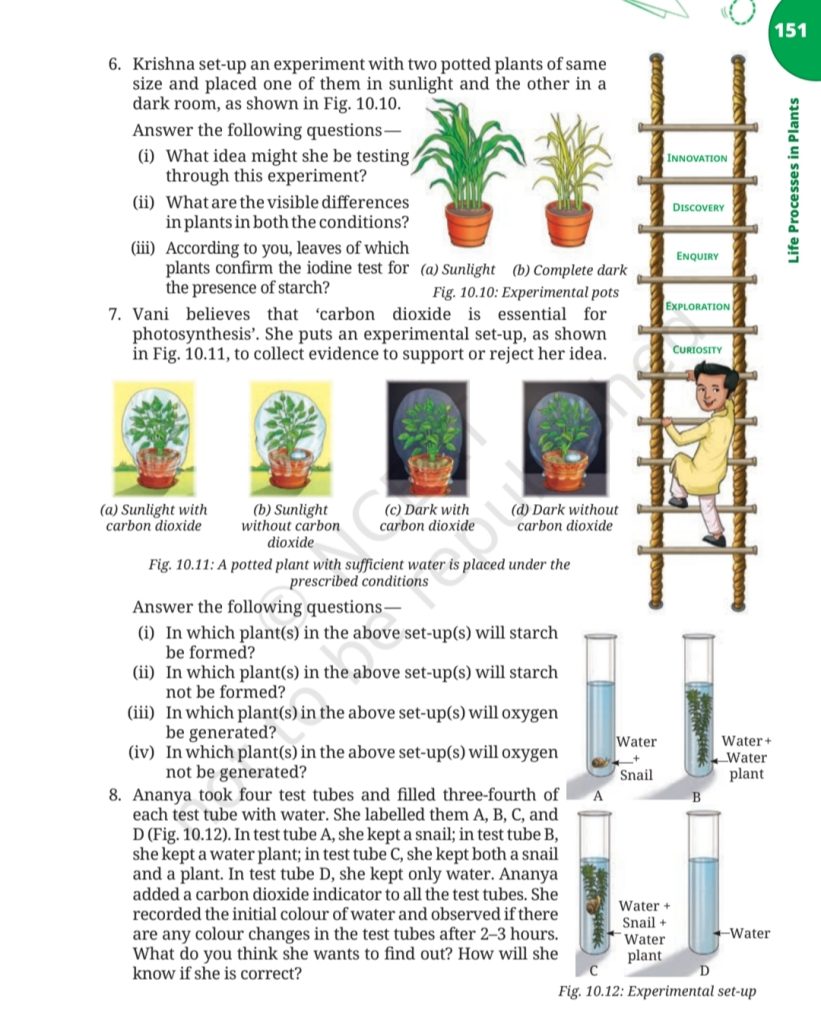
- The process by which plants make food using carbon dioxide, water, sunlight and chlorophyll is called __________.
- Tiny pores on the surface of leaves are called __________ which help in the exchange of gases.
- The __________ transports water and minerals from roots to other parts of the plant.
Section C – True / False
State with reason(s) whether the following statements are True (T) or False (F).
- Lunar eclipse occurs when the Sun comes between the Earth and the Moon. [ ]
- Sunrise happens earlier in Gujarat than in Jharkhand. [ ]
- In Chennai, the longest day occurs on the summer solstice. [ ]
- We should watch the solar eclipse directly with our naked eye. [ ]
- Seasons occur due to the tilt of Earth’s axis of rotation and its spherical shape. [ ]
- The Earth’s revolution around the Sun causes day and night. [ ]
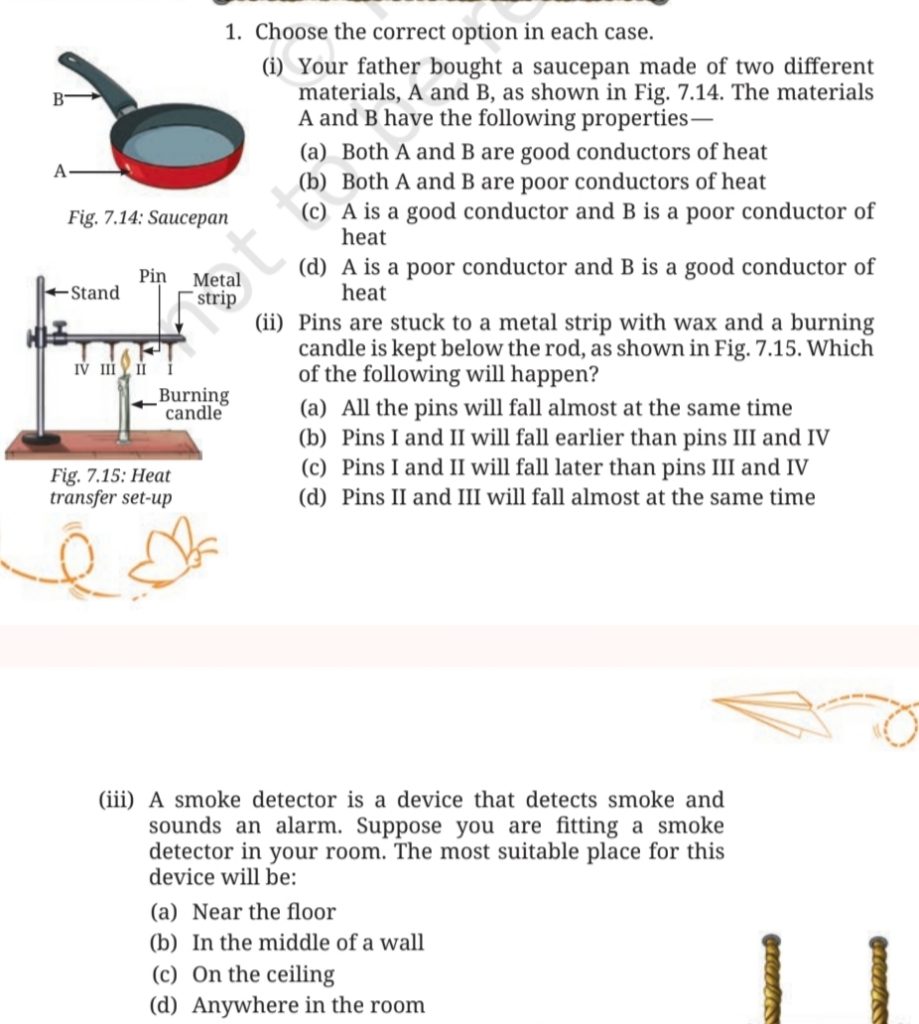
- Heat transfer takes place in solids through convection. [ ]
- Heat transfer through convection takes place by the actual movement of particles. [ ]
- Areas with clay materials allow more seepage of water than those with sandy materials. [ ]
- The movement of cooler air from land to sea is called land breeze. [ ]
Section D – Multiple Choice Question
- What is the role of the diaphragm in breathing?
(i) To filter the air
(ii) To produce sound
(iii) To help in inhalation and exhalation
(iv) To absorb oxygen
Section E – Match the Columns
1. Match the following
| Column A | Column B |
|---|---|
| If the torch is close to the ball | The shadow would be smaller |
| If the torch is far away | The shadow would be larger |
| If the ball is removed from the set-up | A bright spot would appear on the screen |
| If two torches are present in the set-up on the left side of the ball | Two shadows would appear on the screen |
2. Match the following
| Column A | Column B |
|---|---|
| Pinhole camera | Forms an inverted image |
| Opaque object | Blocks light completely |
| Transparent object | Light passes almost completely through it |
| Shadow | The dark region formed behind the object |
3. Match the following
| Name of the Part | Functions |
|---|---|
| (i) Nostrils | (a) fresh air from outside enters |
| (ii) Nasal passages | (b) exchange of gases occurs |
| (iii) Windpipe | (c) protects lungs |
| (iv) Alveoli | (d) tiny hair and mucus help to trap dust and dirt from the air we breathe |
| (v) Ribcage | (e) air reaches our lungs through this part |
Section F – Short Answer Questions
- Four friends used the following ways to see the solar eclipse. Who among them was being careless?
(i) Ravikiran used a solar eclipse goggle.
(ii) Jyothi used a mirror to project the Sun’s image.
(iii) Adithya saw the Sun directly with his eyes.
(iv) Aruna attended a programme arranged by a planetarium.
- Some ice cubes placed in a dish melt into water after sometime.
Where do the ice cubes get heat for this transformation?
Section G – Long Answer Questions
- Explain Solar Eclipse and Lunar Eclipse with diagram.
- A train travels 180 km in 3 h. Find its speed in:
(i) km/h
(ii) m/s
(iii) What distance will it travel in 4 h if it maintains the same speed throughout the journey? - The fastest galloping horse can reach the speed of approximately 18 m/s. How does this compare to the speed of a train moving at 72 km/h?
- Distinguish between uniform motion and non-uniform motion using the example of a car moving on a straight highway with no traffic and a car moving in city traffic.
Class – VII | Subject – Science
Answer Key


Section A – Very Short Answer
- SI unit of time – Second (s)
Section B – Fill in the Blanks
- Stars rise in the east and set in the west.
- Day and night are caused by the Earth’s rotation.
- When the Moon fully covers the Sun from our view, it is called a total solar eclipse.
- Objects that emit their own light are called luminous objects.
- Light travels in a straight line.
- The change in the direction of light by a mirror is called reflection of light.
- All living organisms require food that provide energy for their growth and development.
- The process by which plants make food using carbon dioxide, water, sunlight and chlorophyll is called photosynthesis.
- Tiny pores on the surface of leaves are called stomata which help in the exchange of gases.
- The xylem transports water and minerals from roots to other parts of the plant.
Section C – True / False
- Lunar eclipse occurs when the Sun comes between the Earth and the Moon. False
- Sunrise happens earlier in Gujarat than in Jharkhand. False
- In Chennai, the longest day occurs on the summer solstice. True
- We should watch the solar eclipse directly with our naked eye. False
- Seasons occur due to the tilt of Earth’s axis of rotation and its spherical shape. True
- The Earth’s revolution around the Sun causes day and night. False
- Heat transfer takes place in solids through convection. False
- Heat transfer through convection takes place by the actual movement of particles. True
- Areas with clay materials allow more seepage of water than those with sandy materials. False
- The movement of cooler air from land to sea is called land breeze. True
Section D – Multiple Choice Question
Role of diaphragm in breathing –
(iii) To help in inhalation and exhalation
Section E – Match the Columns
1.
| Column A | Answer |
|---|---|
| If the torch is close to the ball | The shadow would be larger |
| If the torch is far away | The shadow would be smaller |
| If the ball is removed from the set-up | A bright spot would appear on the screen |
| If two torches are present | Two shadows would appear on the screen |
2.
| Column A | Answer |
|---|---|
| Pinhole camera | Forms an inverted image |
| Opaque object | Blocks light completely |
| Transparent object | Light passes almost completely through it |
| Shadow | The dark region formed behind the object |
3.
| Name of the Part | Function |
|---|---|
| Nostrils | (a) Fresh air from outside enters |
| Nasal passages | (d) Tiny hair and mucus trap dust |
| Windpipe | (e) Air reaches our lungs through this part |
| Alveoli | (b) Exchange of gases occurs |
| Ribcage | (c) Protects lungs |
Section F – Short Answer
- Adithya was careless because he saw the Sun directly with his eyes during the solar eclipse, which can damage the eyes.
- Ice cubes get heat from the surroundings (air and dish). This heat causes the ice to melt into water.
Section G – Long Answer
1. Solar Eclipse
A solar eclipse occurs when the Moon comes between the Sun and the Earth and blocks the sunlight from reaching the Earth.
Diagram:
Sun — Moon — Earth
Lunar Eclipse
A lunar eclipse occurs when the Earth comes between the Sun and the Moon and the Earth’s shadow falls on the Moon.
Diagram:
Sun — Earth — Moon
2. Train Speed
Distance = 180 km
Time = 3 h
(i) Speed = Distance ÷ Time
= 180 ÷ 3 = 60 km/h
(ii) Convert to m/s
60 × 5/18 = 16.67 m/s
(iii) Distance in 4 h
Distance = Speed × Time
= 60 × 4 = 240 km
3. Comparison of Speeds
Train speed = 72 km/h
Convert to m/s
72 × 5/18 = 20 m/s
Horse speed = 18 m/s
So, train is faster than the horse by 2 m/s.
4. Uniform and Non-Uniform Motion
Uniform Motion:
When an object covers equal distances in equal intervals of time, it is called uniform motion.
Example: A car moving on a straight highway with no traffic.
Non-Uniform Motion:
When an object covers unequal distances in equal intervals of time, it is called non-uniform motion.
Example: A car moving in city traffic.
