People as Resource – Exercise Solutions
Q1. What do you understand by ‘people as a resource’?
English:
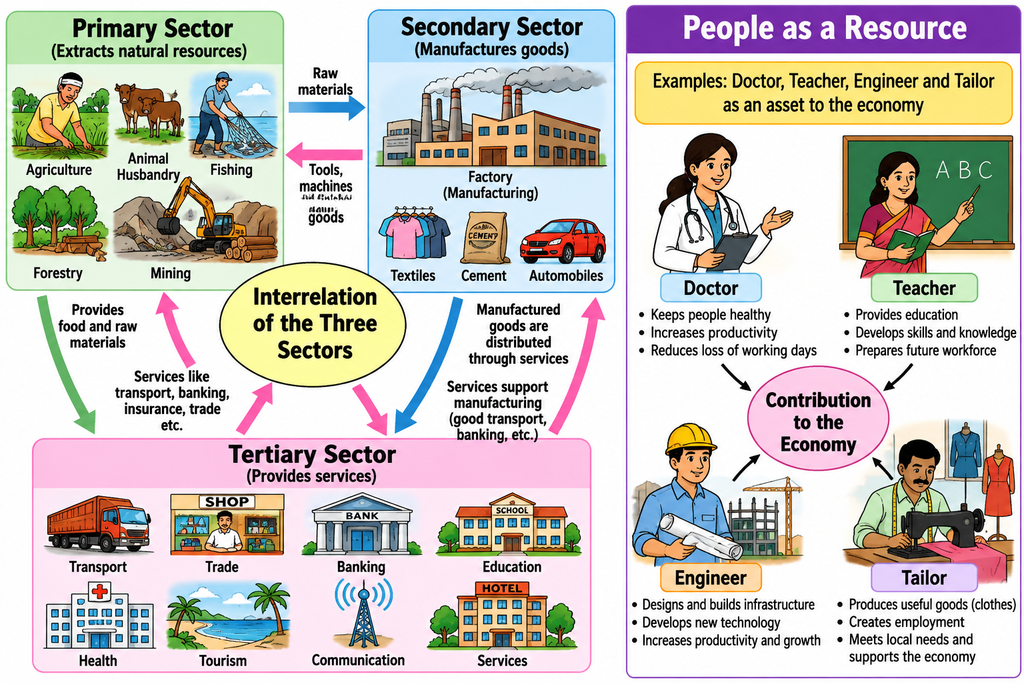
‘People as a resource’ refers to the working population of a country considered in terms of their existing productive skills and abilities. When people are educated, trained and healthy, they become a valuable asset for the economy and contribute to the production of goods and services.
हिंदी:
‘People as a resource’ का अर्थ है देश की कार्यशील जनसंख्या को उनकी उत्पादक कुशलता और क्षमताओं के आधार पर एक संसाधन के रूप में देखना। जब लोगों को शिक्षा, प्रशिक्षण और स्वास्थ्य सुविधाएँ प्राप्त होती हैं, तो वे अर्थव्यवस्था के लिए मूल्यवान संपत्ति बन जाते हैं और वस्तुओं एवं सेवाओं के उत्पादन में योगदान देते हैं।
Q2. How is human resource different from other resources like land and physical capital?
English:
Human resource is different from land and physical capital because human beings can use and develop other resources. Land and physical capital cannot become useful on their own. Educated, skilled and healthy people can make proper and efficient use of land, machines and other resources.
हिंदी:
मानव संसाधन भूमि और भौतिक पूँजी से अलग है क्योंकि मनुष्य अन्य संसाधनों का उपयोग और उनका विकास कर सकता है। भूमि और भौतिक पूँजी स्वयं उपयोगी नहीं बन सकतीं। शिक्षित, कुशल और स्वस्थ लोग भूमि, मशीनों तथा अन्य संसाधनों का कुशलतापूर्वक उपयोग कर सकते हैं।


Q3. What is the role of education in human capital formation?
English:
Education plays an important role in human capital formation. It develops knowledge, skills and abilities in people. It helps individuals to get better employment opportunities and earn higher incomes. Education also increases productivity and contributes to the economic growth of the country.
हिंदी:
मानव पूँजी निर्माण में शिक्षा की महत्वपूर्ण भूमिका है। शिक्षा लोगों के ज्ञान, कौशल और क्षमताओं का विकास करती है। इससे व्यक्ति को बेहतर रोजगार के अवसर मिलते हैं और वह अधिक आय अर्जित कर सकता है। शिक्षा उत्पादकता बढ़ाती है और देश के आर्थिक विकास में योगदान देती है।
Q4. What is the role of health in human capital formation?
English:
Health is an important component of human capital formation. A healthy person can work efficiently and has greater ability to produce goods and services. Good health increases productivity and helps a person realise his or her full potential.
हिंदी:
स्वास्थ्य मानव पूँजी निर्माण का एक महत्वपूर्ण घटक है। एक स्वस्थ व्यक्ति अधिक कुशलता से कार्य कर सकता है और वस्तुओं तथा सेवाओं के उत्पादन में अधिक योगदान देता है। अच्छा स्वास्थ्य उत्पादकता बढ़ाता है और व्यक्ति को अपनी पूरी क्षमता का उपयोग करने में सहायता करता है।
Q5. What part does health play in the individual’s working life?
English:
Health plays an important role in an individual’s working life. A healthy person can work efficiently, remain productive and contribute more to the organisation and economy. Poor health reduces a person’s ability to work and may reduce his or her productivity and income.
हिंदी:
व्यक्ति के कार्य जीवन में स्वास्थ्य की महत्वपूर्ण भूमिका होती है। स्वस्थ व्यक्ति कुशलतापूर्वक कार्य कर सकता है, अधिक उत्पादक होता है तथा संगठन और अर्थव्यवस्था में अधिक योगदान देता है। खराब स्वास्थ्य व्यक्ति की कार्य करने की क्षमता और उत्पादकता को कम कर सकता है तथा उसकी आय भी प्रभावित हो सकती है।
Q6. What are the various activities undertaken in the primary sector, secondary sector and tertiary sector?
English:
| Sector | Activities |
|---|---|
| Primary Sector | Agriculture, forestry, animal husbandry, fishing, poultry farming, mining and quarrying |
| Secondary Sector | Manufacturing |
| Tertiary Sector | Trade, transport, communication, banking, education, health, tourism, services and insurance |
हिंदी:
| क्षेत्र | गतिविधियाँ |
|---|---|
| प्राथमिक क्षेत्र | कृषि, वानिकी, पशुपालन, मछली पालन, मुर्गी पालन, खनन और उत्खनन |
| द्वितीयक क्षेत्र | विनिर्माण/Manufacturing |
| तृतीयक क्षेत्र | व्यापार, परिवहन, संचार, बैंकिंग, शिक्षा, स्वास्थ्य, पर्यटन, सेवाएँ और बीमा |
NCERT में इन तीनों क्षेत्रों और उनकी गतिविधियों का वर्गीकरण इसी प्रकार दिया गया है।
Q7. What is the difference between economic activities and non-economic activities?
English:
Economic activities are activities performed for remuneration or profit. They contribute to the production of goods and services and add to national income.
Non-economic activities are activities performed mainly for self-consumption and without monetary remuneration.
Example:
- A person working in a factory for salary → Economic activity.
- A mother doing household work for her family without payment → Non-economic activity.
हिंदी:
आर्थिक गतिविधियाँ वे गतिविधियाँ हैं जो आय, वेतन या लाभ प्राप्त करने के लिए की जाती हैं। ये वस्तुओं और सेवाओं के उत्पादन में योगदान देती हैं तथा राष्ट्रीय आय में वृद्धि करती हैं।
गैर-आर्थिक गतिविधियाँ मुख्यतः स्वयं के उपभोग के लिए की जाती हैं और इनके लिए मौद्रिक भुगतान नहीं मिलता।
उदाहरण:
- वेतन के लिए कारखाने में काम करना → आर्थिक गतिविधि।
- परिवार के लिए घर का काम करना और उसके लिए भुगतान न मिलना → गैर-आर्थिक गतिविधि।
Q8. Why are women employed in low paid work?
English:
Women are often employed in low-paid work because many women have relatively less education and skill formation. They are also frequently employed in jobs where there is little job security and irregular income. Such employment often lacks facilities like maternity leave, childcare and other social security benefits. However, women with higher education and skills can receive pay comparable to men.
हिंदी:
महिलाओं को अक्सर कम वेतन वाले कार्यों में इसलिए रोजगार मिलता है क्योंकि बहुत-सी महिलाओं को शिक्षा और कौशल के पर्याप्त अवसर नहीं मिल पाते। वे ऐसे कार्यों में भी अधिक संख्या में कार्य करती हैं जहाँ नौकरी की सुरक्षा कम और आय अनियमित होती है। ऐसे कार्यों में मातृत्व अवकाश, बच्चों की देखभाल और अन्य सामाजिक सुरक्षा सुविधाओं का भी अभाव हो सकता है। हालांकि उच्च शिक्षा और कौशल प्राप्त महिलाओं को पुरुषों के समान वेतन मिल सकता है।
NCERT में महिलाओं की शिक्षा, कौशल, रोजगार सुरक्षा और वेतन के बीच इस संबंध को समझाया गया है।
Q9. How will you explain the term unemployment?
English:
Unemployment exists when people who are willing to work at the prevailing wages are unable to find jobs.
हिंदी:
बेरोजगारी उस स्थिति को कहते हैं जब काम करने के इच्छुक लोग प्रचलित मजदूरी पर काम करने के लिए तैयार होते हुए भी रोजगार प्राप्त नहीं कर पाते हैं।
Q10. What is the difference between disguised unemployment and seasonal unemployment?
| Basis | Disguised Unemployment | Seasonal Unemployment |
|---|---|---|
| English | More people are engaged in a job than actually required. | People do not get work during certain months of the year. |
| Example | 8 people work on a farm where only 5 are actually required. | Agricultural workers may have work during sowing and harvesting but little work during other months. |
| हिंदी | आवश्यकता से अधिक लोग एक ही काम में लगे होते हैं। | वर्ष के कुछ महीनों में काम उपलब्ध नहीं होता। |
| उदाहरण | खेत में 5 लोगों की आवश्यकता है लेकिन 8 लोग काम कर रहे हैं। | कृषि मजदूरों को बुवाई और कटाई के समय काम मिलता है, लेकिन अन्य महीनों में काम कम होता है। |
Important point: Disguised unemployment में अतिरिक्त लोगों को हटाने पर उत्पादन में कमी नहीं आती। NCERT में 5 आवश्यक और 3 अतिरिक्त श्रमिकों का उदाहरण दिया गया है।
Q11. Why is educated unemployed a peculiar problem of India?
English:
Educated unemployment is a peculiar problem because many young people with matriculation, graduation and post-graduation degrees are unable to find suitable jobs. At the same time, there is a shortage of people with certain technical and specialised skills. Thus, surplus manpower in some categories exists along with shortage of manpower in others.
हिंदी:
शिक्षित बेरोजगारी भारत की एक विशेष समस्या है क्योंकि मैट्रिक, स्नातक और स्नातकोत्तर डिग्री प्राप्त अनेक युवा उपयुक्त रोजगार प्राप्त नहीं कर पाते। दूसरी ओर, कुछ विशेष तकनीकी और व्यावसायिक कौशल वाले लोगों की कमी होती है। इस प्रकार कुछ क्षेत्रों में मानव शक्ति की अधिकता और कुछ क्षेत्रों में मानव शक्ति की कमी एक साथ दिखाई देती है।
Q12. In which field do you think India can build the maximum employment opportunity?
English:
India can create large employment opportunities in the tertiary sector, especially in services such as information technology, biotechnology, education, healthcare, transport, communication, banking and tourism. Small-scale manufacturing in the secondary sector can also absorb a large number of workers.
हिंदी:
भारत में तृतीयक क्षेत्र (सेवा क्षेत्र) में बड़ी संख्या में रोजगार के अवसर पैदा किए जा सकते हैं। विशेष रूप से सूचना प्रौद्योगिकी, जैव प्रौद्योगिकी, शिक्षा, स्वास्थ्य, परिवहन, संचार, बैंकिंग और पर्यटन जैसी सेवाओं में रोजगार की अच्छी संभावनाएँ हैं। इसके साथ ही द्वितीयक क्षेत्र के लघु-स्तरीय विनिर्माण में भी बड़ी संख्या में श्रमिकों को रोजगार मिल सकता है।
NCERT के अनुसार कृषि सबसे अधिक श्रम-अवशोषित क्षेत्र है, जबकि द्वितीयक क्षेत्र में small-scale manufacturing और तृतीयक क्षेत्र में IT तथा biotechnology जैसी नई सेवाएँ रोजगार पैदा करती हैं।
Q13. Can you suggest some measures in the education system to mitigate the problem of the educated unemployed?
English:
The following measures can help reduce educated unemployment:
- Provide more vocational and skill-based education.
- Link education with employment opportunities.
- Increase technical and professional education.
- Provide practical training and internships.
- Encourage entrepreneurship and self-employment.
- Develop courses according to the needs of industries and the economy.
- Improve the quality of higher education.
हिंदी:
शिक्षित बेरोजगारी को कम करने के लिए निम्नलिखित उपाय किए जा सकते हैं:
- व्यावसायिक और कौशल-आधारित शिक्षा को बढ़ावा देना।
- शिक्षा को रोजगार के अवसरों से जोड़ना।
- तकनीकी और व्यावसायिक शिक्षा का विस्तार करना।
- विद्यार्थियों को व्यावहारिक प्रशिक्षण और इंटर्नशिप देना।
- स्वरोजगार और उद्यमिता को प्रोत्साहित करना।
- उद्योग और अर्थव्यवस्था की आवश्यकता के अनुसार पाठ्यक्रम तैयार करना।
- उच्च शिक्षा की गुणवत्ता में सुधार करना।
Q14. Can you imagine some village which initially had no job opportunities but later came up with many?
English:
Yes. The NCERT chapter itself gives an example of such a village. Initially, the village had very few job opportunities. One boy received education in agricultural engineering and developed an improved plough that increased wheat production. Later, a school was opened and a teacher was appointed. A girl received training in tailoring and started stitching clothes for the villagers. Gradually, new occupations such as agro-engineer, teacher and tailor developed in the village. Thus, investment in human capital created new employment opportunities and prosperity.
हिंदी:
हाँ। NCERT के अध्याय में ऐसे ही एक गाँव की कहानी दी गई है। प्रारंभ में उस गाँव में रोजगार के बहुत कम अवसर थे। एक लड़के ने कृषि अभियांत्रिकी की शिक्षा प्राप्त की और ऐसा उन्नत हल बनाया जिससे गेहूँ का उत्पादन बढ़ गया। बाद में गाँव में स्कूल खोला गया और शिक्षक नियुक्त किया गया। एक लड़की ने सिलाई का प्रशिक्षण लिया और गाँव के लोगों के कपड़े सिलने लगी। धीरे-धीरे गाँव में कृषि अभियंता, शिक्षक और दर्जी जैसे नए रोजगार पैदा हुए। इस प्रकार मानव पूँजी में निवेश से रोजगार के नए अवसर और समृद्धि आई।
यह उदाहरण NCERT के पेज 26–27 पर दिया गया है।
Q15. Which capital would you consider the best — land, labour, physical capital and human capital? Why?
English:
Among land, labour, physical capital and human capital, human capital can be considered the most important because educated, skilled and healthy people can make efficient use of all other resources. Human beings can develop technology, improve production methods and use land and physical capital effectively. Therefore, investment in education, training and health increases the productive capacity of people and the economy.
हिंदी:
भूमि, श्रम, भौतिक पूँजी और मानव पूँजी में मानव पूँजी को सबसे महत्वपूर्ण माना जा सकता है, क्योंकि शिक्षित, कुशल और स्वस्थ मनुष्य अन्य सभी संसाधनों का कुशलतापूर्वक उपयोग कर सकते हैं। मनुष्य नई तकनीक विकसित कर सकता है, उत्पादन की विधियों में सुधार कर सकता है तथा भूमि और भौतिक पूँजी का बेहतर उपयोग कर सकता है। इसलिए शिक्षा, प्रशिक्षण और स्वास्थ्य पर किया गया निवेश लोगों तथा अर्थव्यवस्था की उत्पादक क्षमता को बढ़ाता है।
NCERT भी बताता है कि मानव संसाधन भूमि और भौतिक पूँजी का उपयोग कर सकता है, जबकि भूमि और पूँजी स्वयं उपयोगी नहीं बन सकतीं।
⭐ Quick Revision – Chapter 2
Human Capital Formation = Education + Training + Health
Quality of Population = Literacy + Health/Life Expectancy + Skill Formation
Economic Activities →
- Primary → Agriculture, Fishing, Mining
- Secondary → Manufacturing
- Tertiary → Trade, Transport, Banking, Education, Health, IT etc.
Unemployment →
- Seasonal Unemployment
- Disguised Unemployment
- Educated Unemployment
Main Idea:
Education + Health + Skill → Human Capital → Higher Productivity → Economic Growth
